He Has Been Here the Whole Time: An Introduction to the Holy Spirit
You have heard His name at every Mass, every Baptism, every prayer. It may be time to meet Him.
At a Glance: Pentecost Sunday
Solemnity: 50 days after Easter
Color: Red
Celebrates: The Descent of the Holy Ghost upon the Apostles—tongues as of fire—bringing Pentecost’s New Sinai / New Covenant fulfillment.
Key Scripture: Acts 2:1–11; 1 Corinthians 12:3–7, 12–13; John 20:19–23
The Grandfather They Almost Missed
In Gertrude Chandler Warner’s original Boxcar Children, four orphaned siblings find themselves alone in the world and afraid. Henry, Jessie, Violet, and Benny have heard about their grandfather, James Alden, but what they have heard has not made them eager to find him. The picture they have assembled from fragments and rumors is of a hard and frightening man, someone to be avoided rather than sought. And so they run. They find an abandoned boxcar in the woods and make it their home, resourceful and brave and completely convinced that their grandfather would be worse than whatever difficulty they are already managing on their own.
What they do not know is that their grandfather has been looking for them the whole time.
When they finally meet him, the children discover that everything they feared was wrong. James Alden is warm and generous and so glad to have found them that he does something quietly extraordinary: he has the boxcar moved to his own backyard so the children do not have to leave behind the home they made for themselves. He does not ask them to forget where they came from. He simply brings them in, boxcar and all, and gives them the home they did not know they were looking for.
I have been thinking about that story in relation to the Holy Spirit.
A priest who is a friend of mine said something recently that I have heard before but that landed differently this time. He said that the Holy Spirit is the forgotten Person of the Trinity. He said it gently, almost as a pastoral observation, and then he prayed one of the most beautiful short prayers to the Holy Spirit I have ever heard. And I sat there and realized that I did not really know who he was praying to.
I have been Catholic my whole life. I have heard the Holy Spirit’s name at every Mass, every Baptism, every recitation of the Creed. I received Confirmation, which is specifically about the Holy Spirit. And yet if someone asked me to describe Him, to tell them who He is the way I might describe a person I actually know, I would struggle. I have a picture assembled from fragments, words like advocate and comforter and fire and wind, without a clear sense of the Person those words are trying to describe.
This article is not written from expertise. It is written from honest introduction, an attempt to actually meet the One who has been present and near the whole time. Not waiting to be unlocked by sufficient theological knowledge. Not reserved for mystics and spiritual directors. Here. Close. Looking for us while we were busy convincing ourselves He was something to keep at a respectful distance.
Who He Is, Not What He Is
The first thing worth saying clearly is that the Holy Spirit is a Person.
Not a force. Not a feeling. Not a divine atmosphere that descends on particularly reverent moments and lifts when ordinary life resumes. A Person, with all that the word implies: someone who knows, who loves, who acts, who can be welcomed or ignored, someone you can have a relationship with rather than simply an experience of.
This matters because the way we unconsciously think about the Holy Spirit shapes how we relate to Him. If He is a force, we try to harness Him. If He is a feeling, we chase the feeling. If He is an atmosphere, we try to create the right conditions and hope He shows up. All of those keep us at a slight remove from what Pentecost is actually offering, which is not an experience but an encounter with a Person who is God.
The Church has been clear about this from the beginning. St. Gregory of Nyssa, writing in the fourth century, argues that the Holy Spirit is not joined to the Father and the Son in some respects and separated in others. His union with the Father and the Son is continual and inseparable. The sanctifying power, the life-giving power, the light and comfort and grace that God extends to human beings do not belong exclusively to the Father or exclusively to the Son. They belong to Father, Son, and Holy Spirit together, because the three are one God acting inseparably in the world. When the Holy Spirit acts in you, God is acting in you. Not a lesser version of God, not a divine assistant sent in place of the real thing.
It is also worth naming what the “forgotten Person” language does and does not mean. The Holy Spirit is not absent from the life of the Church. He has never been absent. The forgetfulness is not doctrinal but devotional, a habit of attention rather than a gap in the faith. We recite His name at every Mass. We have simply not always stopped to consider whose name we are reciting.
Jesus told His disciples plainly that it was better for them that He go away, because if He did not go, the Advocate would not come. That is an extraordinary statement. The Son of God, standing in front of people who loved Him, telling them that His departure would make possible something even closer and more interior than His physical presence had been. The Holy Spirit does not operate at a distance. He dwells within. He is the Advocate who comes alongside rather than standing over, the One who teaches us to pray from the inside rather than from the outside.
What Happened at Pentecost
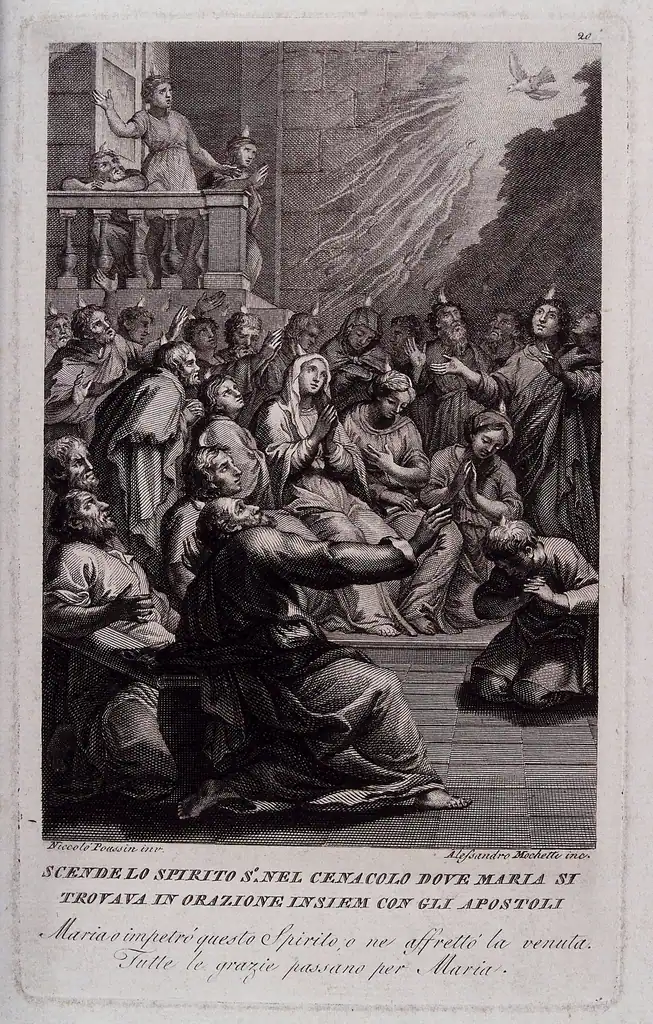
It is fifty days after the resurrection. The disciples are gathered in Jerusalem, in an upper room, behind locked doors. They have seen the risen Christ. They have watched Him ascend. And now they are waiting, though most of them could not have told you exactly what they were waiting for, only that He had told them to wait, and that something was coming.
What comes is not subtle.
The account in Acts 2 describes a sound like a violent rushing wind filling the entire house. Tongues of fire appear and rest on each of them individually, not on the room in general, not on the group as a collective, but on each one. They are all filled with the Holy Spirit and begin to speak in languages they do not know, languages that the crowds gathered outside Jerusalem for the feast recognize as their own. Parthians and Medes and Elamites, people from across the known world, hear the disciples speaking about the mighty works of God in their native tongues. They are bewildered. Some mock. But something has clearly happened that cannot be explained by ordinary means.
Peter, who weeks earlier had denied knowing Jesus three times in the courtyard of the high priest, stands up in front of this crowd and preaches. Not nervously, not with careful qualification, but with a boldness that would have been unrecognizable to anyone who had watched him collapse under the questioning of a servant girl. He proclaims the resurrection. He calls the crowd to repentance and Baptism. Three thousand people are baptized that day.
Something changed in that room.
Father Mark Beard, in a homily on trust, once walked through the apostles one by one and traced what that change actually looked like over the course of their lives. Before Pentecost, the record is striking in its honesty. One out of twelve gets out of the boat to walk on water. Zero out of twelve stay awake in Gethsemane. One shows up at the crucifixion. After the resurrection, none go to the tomb at first. The men who had walked with Jesus for three years could not, on their own strength, hold it together when things got hard.
After Pentecost, we know that every one of them gave his life for the Gospel. And tradition holds that the manner of their deaths was remarkable: Peter crucified upside down, Andrew spending three days on a cross still preaching and refusing to be taken down, Bartholomew skinned alive, Matthew beheaded, James the Lesser thrown from a great height and beaten, Philip speared in India, Simon sawed in half. John alone is believed to have died of old age, though tradition holds they tried to boil him in oil first. These are not remarkable men who found remarkable courage somewhere inside themselves. They are ordinary men who were filled with Someone, and that Someone would not let them stay quiet.
Father Beard’s homily is not a story of human heroism. It is a story of what happens when frightened people stop relying on their own ability and start trusting the One who was poured out in that room.
Pope Paul VI describes Pentecost as the feast at the source of all the other feasts, because without the Spirit poured out that day, the Church’s memory of Christ would not be coherent or fruitful. Pentecost is the moment the Church stops being a group of people who knew Jesus and becomes the Body through which He continues to act in the world. The same Spirit is present and active now, available to the same frightened and hopeful human beings who need exactly what the disciples needed behind those locked doors.
What He Actually Does
If you were introducing someone to a person you actually knew, you would not start with abstractions. You would say: here is what he is like. Here is what he does.
On the night before He died, Jesus promised His disciples that the Father would send them an Advocate, the Spirit of truth, who would teach them everything and remind them of all He had said. The word advocate carries the sense of one who comes alongside, a counselor who does not stand over you issuing instructions but stands with you, inside the situation, offering what you need. This teaching is interior. The Holy Spirit does not only communicate through external sources, through Scripture, through homilies, through articles like this one, though He works through all of those. He also reaches something deeper, the place where identity and courage and conviction are formed.
When you do not know how to pray, when the words will not come and the silence feels empty, that is precisely the moment to ask Him to come and let Him do what you cannot do yourself.
Paul writes to the Corinthians that there are varieties of gifts but the same Spirit, and that the manifestation of the Spirit is given to each person for the common good. The gifts of the Holy Spirit are not spiritual trophies or marks of personal achievement. They are given so that the Body can function, so that the people around you can receive what God wants to give them through you. Wisdom, knowledge, faith, healing, prophecy, discernment, and others are distributed as the Spirit wills, always oriented outward, always building something larger than the individual recipient.
The Spirit also drives mission. The disciples in the upper room had locked the doors. The Spirit blew them open. This is not a personality type or a ministry program. It is what happens to ordinary people when they stop resisting the wind. And He guides into truth, not all the information or all the answers, but truth in the deeper sense, the kind of knowing that changes how you live rather than merely what you can recite.
This renewal is not always dramatic. Sometimes it feels like a quiet shift in what you notice, a patience you did not have yesterday, a forgiveness that surprised you by arriving before you had finished deciding whether to offer it. The Spirit works in the interior, and the interior is not always loud.
He Has Been Here the Whole Time
Remember the grandfather in the boxcar. The children had a picture of him assembled from fear and incomplete information, and they spent the early part of their story running from someone who had been looking for them the whole time. When they finally met him, nothing about them had changed. They just finally knew who had been there all along.
The Holy Spirit has been present at every Mass you have ever attended. He was there at your Baptism, hovering over the water the way He hovered over the waters at the beginning of creation. He was there at your Confirmation, whether you understood what was happening or not. He has been present in every moment of unexpected courage, every inexplicable peace that arrived when the circumstances gave you no reason for it, every prayer that surprised you by meaning more than you intended, every time forgiveness came before you finished deciding to offer it, every time you knew, without being able to explain how, that you were not alone.
That was not a feeling. That was a Person.
He is not the forgotten Person of the Trinity because He has been absent. He is forgotten through a picture assembled from too little, approached from too far away. He has been here the whole time, closer than you realized, looking for you while you were busy deciding whether He was safe to approach.
He is safe. He is better than safe. He is the One Jesus said it was worth His own departure to send. The Advocate who comes alongside. The fire that rests not on the room in general but on you, specifically, by name. The interior Master who teaches you to pray when you do not know how. The wind that fills the sails and moves the ship somewhere.
You do not have to have it figured out. You do not have to be further along than you are. You just have to ask Him to come.
Prayer to the Holy Spirit
Come, Holy Spirit, fill the hearts of your faithful And kindle in them the fire of your love. Send forth your Spirit, and they shall be created. And you shall renew the face of the earth.
O God, who by the light of the Holy Spirit Did instruct the hearts of the faithful, Grant that by the same Holy Spirit we may be truly wise And ever enjoy His consolations. Through the same Christ our Lord. Amen.


You May Also Like

Remaining When It Feels Like Too Much
The Burning Heart of Jesus Still Waits for Yours