Martha Became a Saint Too
She was busy, worried, and sometimes got it wrong. So do we. That’s not the end of the story.
St. Martha (Virgin) – Sister of Mary and Lazarus of Bethany
Feast Day: July 29
Died: First century
Venerated: From antiquity; commemorated in the Church’s liturgical calendar
Known for: Hospitality and faithful service to Christ
I. The One Who Kept the House
There is a village called Bethany, about two miles east of Jerusalem on the far slope of the Mount of Olives, and in that village there is a house where Jesus is welcome. Not merely tolerated or received with nervous deference, the way a rabbi might be received by people unsure of the protocol, but genuinely, warmly welcome. The Gospel of John notes it plainly, almost as a piece of background information that the reader should already know: Jesus loved Martha and her sister and Lazarus. It is a household of friendship. And like most households of friendship, it has someone who makes that friendship possible in concrete, practical terms. That someone is Martha.
She is the one who opens the door. She is the one who sees to it that a guest is made to feel that his presence is not an imposition. In a first-century Jewish home, this was no small thing. Hospitality was not a preference or a personality type. It was a moral obligation, a participation in the covenant generosity of God toward his people. To receive a guest well was an act of faith. Martha would have understood this. She does not host Jesus out of mere affability. She hosts him because she loves him, and because love, for Martha, has always expressed itself in the language of doing.
This is worth pausing on before anything else, because the temptation when approaching Martha is to begin already bracing for the correction, to read her as a cautionary tale waiting to happen, a warning label attached to the virtue of industry. That reading misses something important. Jesus does not visit this house reluctantly, or out of obligation, or because no better option presented itself. He comes back, more than once. He weeps there. He raises the dead there. Bethany is, in some real sense, his home away from home, and Martha is one of the reasons why. Her love is real. Her service is real. The house she keeps is one of the few places in the Gospels where the Son of God is received as a friend.
She is not a type before she is a person. She is a woman with a particular way of loving, and Jesus receives that love.
II. Worried and Distracted by Many Things
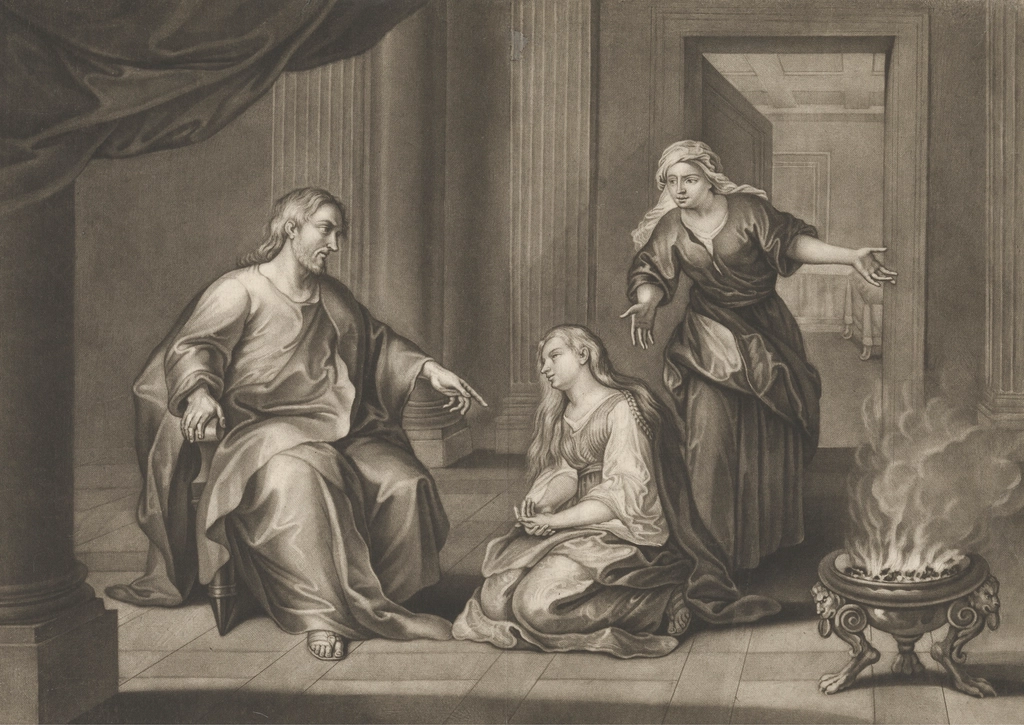
And yet. The scene in Luke 10 is so familiar it has almost lost its capacity to sting, and it is worth reading it slowly enough to let it sting again.
Jesus has come to the village. Martha opens the door, of course she does, and almost immediately the weight of having him there settles onto her shoulders. There is so much to do. A guest like this requires real preparation, real attention, and her sister is simply sitting there at Jesus’s feet while Martha moves from task to task, increasingly aware that she is doing this alone. At some point the awareness tips over into something sharper: frustration, maybe a trace of resentment, and finally a complaint addressed not to Mary but to Jesus himself. Lord, do you not care that my sister has left me to serve alone? Tell her then to help me.
It is an extraordinarily human moment. She is not being malicious. She is not being selfish in any ordinary sense. She is working herself to exhaustion in service of the very person she is addressing, and she cannot understand why that does not seem to count for more. The feeling is recognizable to anyone who has ever kept a household running, managed a family’s needs, held a job and come home to a second job’s worth of tasks, and quietly wondered whether any of it registers, with the people around them, or with God.
Jesus’s answer is gentle and it is firm: Martha, Martha, you are anxious and troubled about many things, but one thing is necessary. Mary has chosen the good portion, and it will not be taken from her.
The Church’s spiritual tradition has consistently understood this not as a condemnation of Martha’s service, but as a correction of anxious distraction. Thomas Aquinas, commenting on this passage, draws the classic distinction: Martha represents the active life, Mary the contemplative, and both are genuine expressions of Christian discipleship. The active life is not lesser. Service is not a mistake. What Jesus is pointing to is something more interior, a quality of attention, a posture of the heart. Martha is not wrong to prepare and receive and care for her guest. She is wrong, in this moment, to let the doing swallow the being. Her service has become anxious self-sufficiency, a project she is managing rather than a gift she is offering.
Teresa of Ávila, who had no patience for false piety and considerable experience managing the practical demands of founding monasteries across Castile, put it with characteristic directness: Martha and Mary must go together in entertaining our Lord. She understood from her own life that contemplation without action collapses into self-absorption, and that action without contemplation collapses into something else, the frantic, depleting busyness that Jesus names in Martha’s kitchen. The goal is not to stop being Martha. The goal is to let Mary’s posture of attentiveness come first, so that Martha’s work flows from love rather than anxiety.
This is harder than it sounds, and if you have ever found yourself moving through a full day, school drop-offs, work, dinner, laundry, the inbox that never empties, with a background hum of if I can just get through this list, if I can just do a little more, surely God will notice, surely things will ease, then you already know why it is harder than it sounds. The impulse is not bad. It is, in its own way, a form of faith: the belief that faithfulness in small things matters, that showing up and doing the work is a kind of prayer. And it is. The problem comes when the doing quietly substitutes for the receiving, when the busyness becomes a way of earning what has already been given freely, when the striving is really a hedge against the terrifying vulnerability of simply asking.
Jesus is not telling Martha to sit down and let the dinner burn. He is telling her that she has, somewhere in the middle of all her good and loving work, lost track of why she is doing it. The one thing necessary is not less service. It is the heart from which real service flows.
III. Lord, If You Had Been Here
Four days have passed since Lazarus died. Four days of mourning, of neighbors coming and going, of Mary and Martha waiting in the house while the grief settles into something heavy and permanent. And then word comes that Jesus is approaching the village.
Martha goes out to meet him.
It is worth noting, because it is so consistent with who she is. She is the one who moves. She is the one who acts. Even here, even now, even gutted by grief and four days of waiting and the particular exhaustion of having watched someone you love die while waiting for a friend who did not come in time, Martha is still the one who gets up and goes. But there is nothing of the kitchen in this movement. She is not managing anything. She has nothing left to manage. She goes out to meet Jesus the way a person goes out when they have run out of options and there is nowhere else to turn.
What she says when she reaches him is not a greeting. It is the rawest possible statement of where she has been living for four days: Lord, if you had been here, my brother would not have died. There is love in it, and there is grief, and if we are reading honestly, there is probably something that sits close to accusation. You could have come. You knew. You loved him, the messenger said so, we told you plainly, and you did not come in time. She is not performing faith here. She is not offering a tidy spiritual reflection on the mystery of suffering. She is standing in front of Jesus with four days of anguish on her face and saying the truest thing she knows.
And then, almost in the same breath, something else surfaces. But even now I know that whatever you ask from God, God will give you. It is a remarkable sentence. She does not know what she is hoping for. She cannot bring herself to ask for the specific thing, perhaps because asking for it out loud would mean risking the hope she is barely holding together. What she offers instead is a kind of open-handed, exhausted trust, not the bright faith of someone who has not yet been tested, but the threadbare faith of someone who has been tested and has nothing left to offer except the thread itself.
It is worth pausing on a detail that John’s Gospel quietly emphasizes. It is Martha, not Mary, not one of the Twelve, not a figure of obvious theological stature, whom Jesus meets on the road and chooses as the recipient of his most direct and shattering self-revelation. The woman who was gently corrected in the kitchen, the one whose anxiety Jesus named with such care, is the one who goes out to find him in her grief and is met with the deepest mystery the Gospel contains. He does not wait for the most spiritually composed person in the room. He meets the person who came out to find him, carrying everything she had left.
IV. I Am the Resurrection and the Life
Jesus asks her a question before he makes the declaration. I am the resurrection and the life. Whoever believes in me, though he die, yet shall he live, and everyone who lives and believes in me shall never die. And then, looking at this woman standing before him in her grief: Do you believe this?
It is not a rhetorical question. He wants an answer. And Martha gives one that has echoed through twenty centuries of Christian faith: Yes, Lord; I believe that you are the Christ, the Son of God, who is coming into the world.
Aquinas, in his commentary on this passage, notes that Jesus is leading Martha to higher things, drawing her faith upward from the general resurrection she already believes in toward the specific, immediate, embodied power standing in front of her. Martha’s confession is not the product of a calm theological reflection. It arrives wrung out of her, offered from a place of depletion rather than abundance. She does not fully understand what she is confessing. She will walk back to the tomb, watch the stone rolled away, and still have to be reminded that her brother will rise. The faith is real and the comprehension is partial and Jesus works with both.
This is the moment the whole article has been moving toward, and it is worth sitting in it rather than rushing past it toward the miracle. The raising of Lazarus is extraordinary. But what happens here, in this exchange between a grieving woman and the Son of God, is its own kind of resurrection. Martha arrived at this conversation carrying the weight of her loss, her confusion, her half-formed hope, and the memory of a gentle correction she received the last time Jesus was in her house. She offers all of it. She has nothing else. And into that emptiness Jesus speaks the words that are the ground of every Christian hope.
You do not have to wait until you are this empty. That is worth saying plainly. The invitation of the Gospel is not to exhaust yourself first and encounter God second, as though depletion were a prerequisite for grace. Jesus was trying to reach Martha in the kitchen too, before things got to this point, and his correction there was itself a form of mercy, an attempt to loosen the grip of anxious striving before it cost her something she could not get back. The one thing necessary is available in ordinary time, not only in extremity.
But if you are already at the tomb, if the grief or the exhaustion or the long accumulation of doing-without-receiving has brought you to the place where you have nothing polished left to offer, where the best you can manage is Lord, if you had been here, then hear what the Gospel says about that place. It is not a place of abandonment. It is the place where Jesus makes his most direct declarations. The woman who arrives empty-handed, holding a thread of hope she cannot even articulate, is the woman to whom he says: I am the resurrection and the life.
Martha came to him with her lack, and he met her with everything.
V. She Became a Saint Too
The story does not end at the tomb. That is the first thing worth noting, because it would be easy to read the John 11 scene as the climax of Martha’s spiritual life, the moment she finally got it right, arrived at the proper posture, made the great confession, and leave her there, frozen in her finest hour. But the Gospels don’t do that. In John 12, six days before the Passover, Jesus comes to Bethany again. There is a dinner. Lazarus is at table. Mary takes a jar of expensive ointment and anoints Jesus’s feet. And Martha, Martha is serving.
She is still doing what she has always done. She is still the one who makes sure there is food, that the guest is received, that the household is in order. The correction she received in Luke 10 did not turn her into Mary. The revelation she received at the tomb did not remove her from the kitchen. What changed, we can reasonably believe, is the interiority she brings to the work, the ground from which the serving now flows. Teresa of Ávila was right: Martha and Mary must go together. Not as a compromise between two competing spiritualities, but as a single integrated life in which the sitting makes the serving possible, and the serving expresses what the sitting has received.
Monsignor James Shea once told a story about a married couple he knows, from before they even started dating. They were on a camping trip with friends, and as the evening turned cold, the woman walked over and sat on the edge of the man’s chair and said, simply, I’m cold. It was an invitation, to closeness, to intimacy that went beyond mere friendship. The man, entirely missing the invitation, jumped up and said he would make a fire. He spent the next hour gathering wood, building it up, tending it carefully. When he finally sat back down, he sat in a different chair.
Monsignor Shea uses the story to describe something that happens in the spiritual life with uncomfortable regularity. God draws near. He invites us into intimacy, into the simple, unearned warmth of being loved. And we, well-intentioned and energetic and genuinely wanting to respond, jump up to build a fire. We serve. We organize. We add another commitment, another act of devotion, another thing we can point to as evidence that we take this seriously. And somewhere in the middle of all that industry, we end up sitting in a different chair.
This is not a story about service being wrong. The fire is not a bad thing. A warm camp is better than a cold one, and the Church genuinely needs people who will get up and do the work. The problem is the sequence, doing instead of receiving, building instead of abiding, offering God our productivity when what he is asking for is our presence. He does not need the fire. He wants to sit with you.
Martha received that invitation, and it reoriented everything. She went back to her kitchen, and she served, but now from a different place, with a heart that had been emptied out and filled back up at the tomb of her brother. The work looked the same from the outside. The inside was different. And across a lifetime of ordinary love ordered toward God, she became a saint.
So can you. Not by doing more, not by building a larger fire, not by earning through industry what has already been given freely. The one thing necessary is available to you in the middle of your full and demanding life, not only on the other side of it. You do not have to manufacture stillness you do not have. You do not have to wait until you are broken open the way Martha was at that tomb, though if that is where you find yourself, know that it is precisely there that Jesus makes his most direct declarations. He meets us where we are. He calls us by name. He asks if we believe. And when we offer him the thread of whatever faith we have left, he does not turn away from it.
Martha was worried and distracted by many things, and she became a saint. So can you.
St. Martha, pray for us. Pray that we would stop long enough to sit with Him before we rush off to serve Him. Pray that we would trust that He has already taken care of everything, and that our work is only ever a response to that, not an attempt to earn it. And on the days when we arrive empty, with nothing left to offer but the thread of our hope, pray that we would have the courage to go out and meet Him anyway. Amen.


2 Comments
Pat
Mike, I am overwhelmed and stunned by the beauty of your article. It leaves me with tears in my eyes- am literally crying while reading this. You see so deeply into the nature of things. God is surely using you to reach people. You need to be published!
Mike
Thank you so much, this really means a lot to me! I am just grateful to get to share my thoughts on things that I struggle with in hopes that it helps encourage others to keep chasing after God.