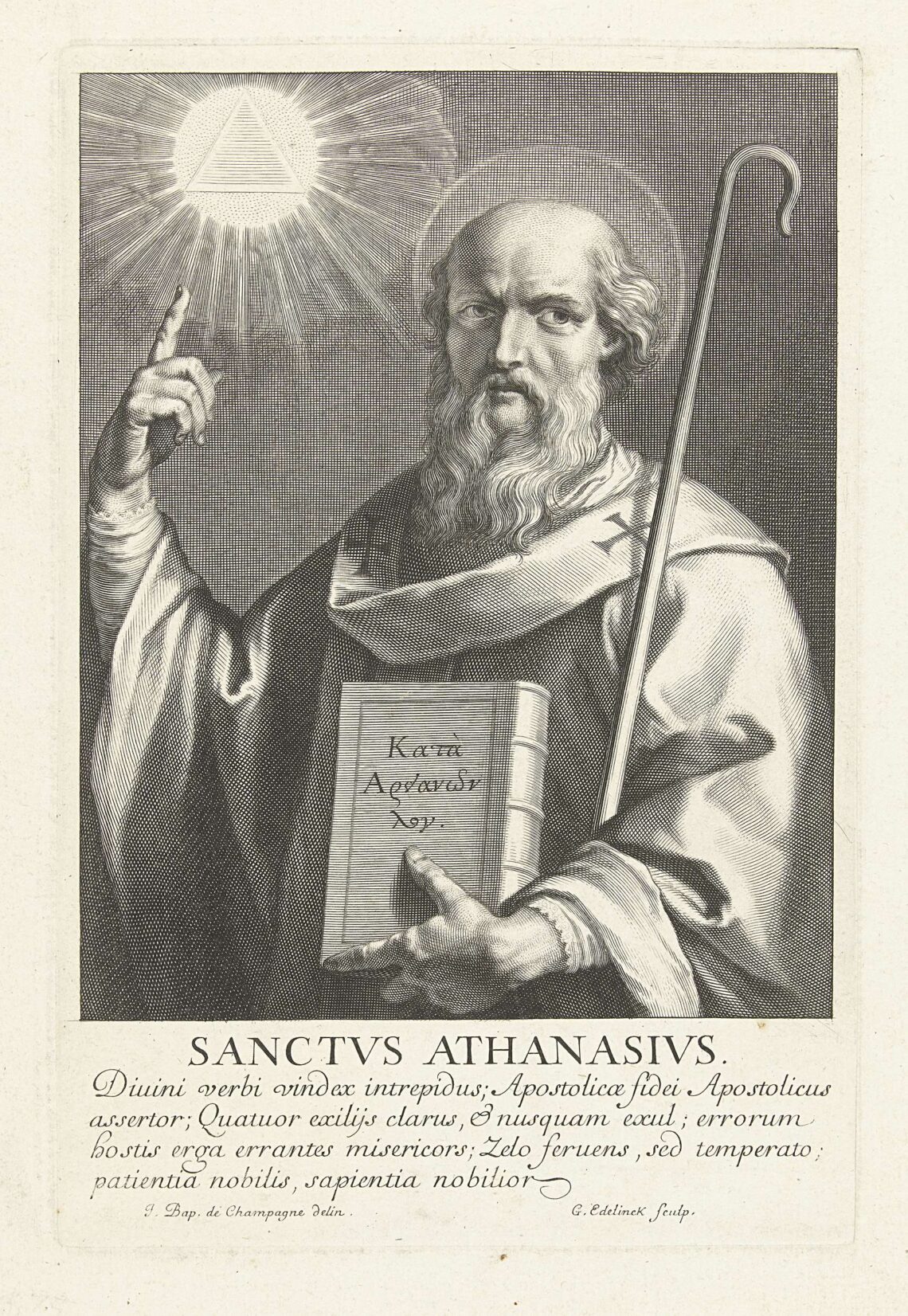
Athanasius Against the World: The Bishop Who Refused to Let Go
One council. One creed. One bishop who would not let go of either. This is the story of Athanasius of Alexandria.
Bishop and Doctor of the Church
Feast Day: May 21
Born: c. 296–298, Alexandria, Egypt
Died: May 2, 373, Alexandria
Bishop of Alexandria: 328–373
Exiled: five times for defending Nicene orthodoxy against Arianism
Doctor of the Church: affirmed in the Church’s liturgy
Known for: champion of the divinity of the Son / the Incarnation; “Father of Orthodoxy”; key witness connected to Nicaea
I. One Man, One Creed
In 325 AD, bishops from across the Christian world gathered at Nicaea and settled, in precise theological language, what the Church believed about Jesus Christ. The Son of God, they declared, is of the same substance as the Father — not a creature, not a lesser being, not a god of a lower order. The debate was over. The faith was defined.
And then almost everything fell apart.
In the years that followed, the theological and political pressures against the Nicene confession mounted steadily. Emperors proved unreliable. Bishops who had signed the creed began to distance themselves from its implications. The machinery of the imperial court ground against the men who insisted the council’s words meant what they said. And one bishop — exiled repeatedly, accused falsely, abandoned by allies, opposed by emperors — simply refused to let go.
His name was Athanasius of Alexandria, and the phrase that has followed him through history is Athanasius contra mundum — Athanasius against the world. It is worth being precise about what that phrase means and what it does not. It does not mean he was right because he was stubborn, or that his instinct for conflict was itself a virtue. It means that when the pressure to compromise the Church’s defined confession became almost universal, he treated that confession as non-negotiable — because it was. The world was wrong. The creed was right. He held on.
He almost didn’t accept the role that would define his life. When his predecessor Alexander lay dying and indicated that Athanasius should succeed him as Bishop of Alexandria, Athanasius fled. He did not want the office and everything it would demand. Alexander, knowing his man, reportedly called after him: “O Athanasius, you think to escape — but you will not escape.”
He didn’t.
II. The World He Was Born Into
To understand what Athanasius was up against, it helps to understand the world that formed him.
He was born around 296 or 298 AD in Alexandria — at that time the intellectual capital of the ancient world. The city was home to the greatest library in antiquity, a hub of philosophy, commerce, and theological argument. It was a place where ideas were taken seriously, debated fiercely, and spread quickly. It was also, by the time Athanasius came of age, a city in the middle of one of the most consequential transformations in human history.
The Emperor Constantine had extended legal toleration to Christians in 313 AD, ending centuries of intermittent persecution. Churches that had been destroyed were rebuilt. Clergy were honored. The faith that had survived by going underground was suddenly permitted to exist in the open — and then, rapidly, to flourish under imperial favor. It was an extraordinary reversal, and it came with a complication no one had quite anticipated: a Church that was free to settle its internal disputes was also suddenly exposed to political pressure about how those disputes should be settled.
Who Arius Was — and What He Actually Taught
Into this environment came a priest named Arius, and a teaching that would fracture the Church for generations.
Arius taught that the Son of God, while exalted above all other creatures, was nonetheless a creature — a being who had a beginning, who came into existence at a point in time, who was made by God rather than being God in the fullest sense. In his formulation, there was a time when the Son was not. The Father alone was eternal, uncreated, and without beginning. The Son was the greatest of God’s works — but a work nonetheless. The council’s own documents preserve the specific claims it was condemning: those who say the Son “was not before he was begotten,” that he is “from things that were not,” that he is “a creature” or “subject to change” — these Nicaea anathematized by name.
The appeal of the Arian position is worth noting. The idea that the Father alone is fully and originally God has a certain intuitive plausibility — particularly for people from a Jewish or philosophical background that stressed the absolute unity and transcendence of God. The Son as a supremely exalted mediating figure, less than the Father but far above humanity, can seem like a reasonable way of holding together monotheism and the obvious worship the early Church directed toward Christ. It was wrong — but it was not obviously wrong to everyone who encountered it. That is partly why it spread.
The Young Deacon at Nicaea
Athanasius attended the Council of Nicaea as a young man in the retinue of his bishop, Alexander of Alexandria. He had already, before the council, written early treatises defending the full divinity of Christ. He was present at Nicaea in an early stage of his ministry — watching, learning, and already formed in the convictions that would define the rest of his life.
He was in the room where it happened. And what was decided in that room would cost him enormously.
III. Nicaea and the Word Homoousios
The Council of Nicaea produced a creed — the ancestor of the Nicene Creed still prayed at Mass every Sunday. At its heart was a single Greek word that the council’s fathers chose with care precisely because it was difficult to evade: homoousios.
Of the same substance as the Father.
Not similar. Not like. Not of a comparable nature. The same substance — meaning that whatever the Father is in his divine being, the Son is also. They share one divine nature. The Son is not a copy of God or a representation of God or a creature so elevated that he resembles God. He is God, fully and without qualification, in the same sense that the Father is God.
The word was controversial precisely because it was so hard to soften. Arius and his supporters had shown considerable skill at adopting language that sounded orthodox while meaning something different — affirming, for instance, that the Son was like the Father, or even like the Father in all things, while still maintaining that the Son was ultimately a creature. Homoousios closed those exits. It said not like but same — and same in substance, which is the category that matters most.
What Was Actually at Stake
This was not a quarrel about vocabulary. The orthodox bishops at Nicaea understood that the language chosen would either hold the line or allow it to be gradually redrawn — and the attempts to redraw it came quickly.
In later decades, the Arian party would press to have the Nicene terms removed from the creed entirely — arguing that words like substance and of one substance were non-scriptural and philosophically loaded. The orthodox counter-argument was straightforward: it is unlawful to make any change in doctrines defined at Nicaea. To add or subtract from the defined language opens the door to precisely the manipulation it was designed to prevent. Once the language is flexible, the meaning becomes flexible. And once the meaning is flexible, the faith can be made to say whatever the most powerful voices in the room need it to say.
This is the argument Athanasius spent his life making. The creed says what it says. The council defined what it defined. The pressure to soften, to nuance, to find more politically acceptable formulations — however it was dressed — was pressure to abandon the Church’s confession about who Jesus Christ actually is.
He would not do it. Not under Constantine. Not under Constantius. Not under Julian. Not under anyone.
IV. The Shape of a Life — Exile, Return, Exile Again
Athanasius became Bishop of Alexandria around 328 AD, succeeding Alexander. He did not want the office. He attempted to avoid it — unwilling to step into what he already understood would be an unrelenting conflict. He was compelled to accept. Alexander’s prophecy had been accurate.
What followed was an episcopate unlike almost any other in Church history: decades of faithful ministry repeatedly interrupted by exile, false accusation, imperial pressure, and the particular loneliness of a man who watches his allies capitulate one by one while he refuses to.
The Political Machinery
The opposition Athanasius faced was not primarily theological argument. It was machinery — the systematic use of political, legal, and ecclesial mechanisms to remove him from his see. Councils were packed with his opponents. Accusations were manufactured. Imperial favor shifted. Each time he was removed and a more accommodating bishop installed in his place, the strategy was the same: make it appear that Athanasius was simply gone, that the see had moved on, that the Nicene confession was no longer the position of the Alexandrian church.
It never worked permanently. He kept coming back.
The Pattern
Traditional accounts describe Athanasius being driven into exile on multiple occasions across his long episcopate — summoned before hostile councils, condemned on charges that were later shown to be false or politically motivated, banished to distant cities, and yet consistently returning to Alexandria when the political winds shifted. Under Julian, the opposition became openly dangerous: according to Theodoret, Julian’s sentence against Athanasius amounted to a condemnation not merely to exile but to death, and Athanasius escaped only by flight and concealment.
Through all of it, he wrote. Letters to his flock in Alexandria maintaining pastoral connection across the distance. Doctrinal letters defending and restating the Nicene faith. Theological communications holding scattered communities together and reminding them of the confession they had made at baptism. He was a bishop in exile. He remained a bishop.
Faithfulness, Not Stubbornness
It would be easy, and wrong, to read Athanasius’s resistance as the expression of a combative personality — a man who happened to be on the right side of a theological dispute and who also enjoyed the fight. He tried to flee the episcopate. He appealed through legitimate channels. He sought hearings rather than simply refusing to engage.
What he refused to do was compromise the defined confession of the Church about who Jesus Christ is. That is a different thing entirely from stubbornness. Stubbornness holds on because letting go feels like defeat. Athanasius held on because the alternative was not merely personal defeat but the falsification of the Gospel. Athanasius contra mundum means that when the world — including much of the institutional Church — moved toward accommodation with Arianism, he treated the Nicene definition as the boundary that could not be crossed. Not because he had drawn it, but because the Church had.
V. Why It Mattered — The Theology Behind the Fight
It is possible to follow the drama of Athanasius’s life and miss the reason any of it mattered. The reason is theological, and it is worth stating clearly.
What Nicaea Condemned
The Council of Nicaea anathematized specific claims about the Son of God: that he “was not before he was begotten,” that he is “from things that were not,” that he is “a creature” or “subject to change.” The language is not abstract. It is the Church drawing a line around a specific truth: the Son of God is not a created being. He did not come into existence at a point in time. He is God, fully and without qualification, co-eternal with the Father.
Why does this matter beyond the satisfaction of getting the answer right?
The Implication
Because salvation depends on it.
Humanity is not merely in need of instruction, or inspiration, or a supreme moral example. Humanity is in a condition — fallen, corrupted, severed from the source of its life — that it cannot repair from within itself. What is needed is not a very good creature showing other creatures how to live. What is needed is God entering the human condition and, from within it, doing what only God can do.
A created savior — however exalted, however close to God, however sinless — remains on the creaturely side of the divide. Only God can cross from the divine side to the human side and bring humanity back with him. This is why Nicaea’s language was non-negotiable. It was protecting not a piece of theology but the possibility of genuine redemption — the reality that what God accomplished in Christ was not the sending of a representative but the actual coming of God himself into human flesh.
“God Became Man So That Man Might Become God”
Athanasius expressed this with a phrase that has echoed through Christian theology ever since: “God became man so that man might become God.”
The second half requires care. It does not mean human beings become divine in the same sense that God is divine — shedding creatureliness and becoming uncreated. It means what the tradition calls theosis or divinization: that by genuine union with God in Christ, human beings are granted a participation in the divine life that creaturely existence could never reach on its own. We become, by grace, what God is by nature.
This is only possible if the Christ who accomplished it is genuinely, fully, substantially God. A Christ who is merely the highest of creatures can offer elevation within the creaturely order. Only a Christ who is homoousios — of the same substance as the Father — can offer participation in the divine life itself.
This is what Athanasius was defending. Not a word. Not a council’s prestige. The truth on which every baptized person’s hope of salvation rests.
VI. Writing From Exile — Letters as Lifelines
There is a temptation, when telling the story of a theologian and bishop, to locate his significance in the dramatic confrontations — the councils, the exiles, the face-offs with emperors. But Athanasius’s significance was equally expressed in something quieter: the steady pastoral work of a bishop who refused to abandon his flock even when physically separated from them.
Letters Across the Distance
Through his exiles, Athanasius wrote to his people in Alexandria. These were not triumphalist letters asserting his own righteousness or condemning his enemies. They were pastoral letters — maintaining connection, providing guidance, reminding the faithful of the confession they had made at baptism and of the bishop who had not forgotten them.
One of his opponents’ consistent strategies was to install a replacement bishop in Alexandria — to make it appear that Athanasius was simply gone, that the see had moved on. The letters were a counter to this. They said, quietly and persistently: I am still your bishop. The faith we confess together has not changed. Hold on.
Doctrinal Letters and the Defense of Nicaea
Athanasius also wrote doctrinal letters — precise theological communications defending the Nicene faith. One such letter, preserved in the writings of Theodoret, functions as a doctrinal boundary marker: the faith confessed at Nicaea is the faith preached from the beginning. Those who claim to accept the council while distorting the meaning of homoousios — who say the Son is a creature while using language that sounds orthodox — are not offering an alternative interpretation. They are offering a different religion.
The letter states the orthodox position plainly: to add or subtract from what Nicaea defined is to become an accuser of the fathers who defined it. The Nicene confession is not one theological proposal among many. It is the Church’s settled answer to a settled question, and settled answers deserve the protection of settled language.
Fidelity, Not Heroism
It would be a mistake to read Athanasius’s writing as the product of a man who found exile bracing or conflict energizing. He wrote because his people needed him to write. He defended the creed because the creed needed defending. He maintained contact with scattered communities because those communities needed a bishop — and he was their bishop, and geography did not change that.
His writing was not heroism dressed in theological language. It was the ordinary work of a pastor doing what pastors do — teaching, guiding, correcting, encouraging — under extraordinarily difficult circumstances. The extraordinary thing was simply that he kept doing it.
VII. Athanasius Today
The situation Athanasius faced is not as distant as it might appear.
The specific heresy is different. No one in the contemporary Church is formally proposing that the Son of God is a creature who had a beginning in time. Nicaea settled that question, and it stayed settled. But the pattern Athanasius navigated — the pressure to soften defined doctrine, to find more accommodating language, to treat the Church’s settled confessions as negotiable in the face of cultural or political pressure — that pattern has not gone anywhere.
The pressure rarely arrives as open heresy. It arrives as reasonable-sounding procedural argument. The Church’s defined language is non-scriptural, philosophically loaded, creating unnecessary division. Surely a more flexible formulation could preserve the essential meaning while reducing conflict. The orthodox response then was not a philosophical refutation of these arguments. It was a principled refusal to treat defined doctrine as a starting point for negotiation. The Church has spoken. The council has defined. To add or subtract from that definition — however reasonable the justification offered — is to open the door to the very manipulation the definition was designed to prevent.
This is not a medieval problem. It is a permanent problem.
What Contra Mundum Actually Means
The phrase Athanasius contra mundum has acquired a romantic quality — the lone hero standing against the corrupt establishment, righteous precisely because he is isolated. This reading is seductive and almost entirely wrong.
Athanasius was not right because he was alone. He was not heroic because he was stubborn. The value of his position was not its unpopularity but its truth. If the Nicene confession had been wrong, his fidelity to it would have been a scandal rather than a witness. The point is not that one man stood against the world. The point is that the world, in this instance, was wrong — and that what the world was pressuring the Church to abandon was the confession on which the entire Gospel rests.
Contra mundum as a vocation is not a personality type. It is the specific demand placed on every Christian — and more acutely on those in positions of teaching authority — to hold the defined faith of the Church against whatever pressure is brought to bear. Not because holding it is satisfying, but because it is true.
The Honest Distinction
There is a difference between a person who holds on because something is true and a person who holds on because they enjoy the fight. Athanasius tried to flee his episcopate. He sought legitimate hearings. He appealed through proper channels. When he stood firm, it was not because standing firm felt good. It was because the alternative was to let go of something that could not be let go of without catastrophic loss.
The contra mundum instinct, detached from genuine theological content and grounded merely in contrarianism, produces not saints but polemicists — people who mistake the pleasure of opposition for the virtue of fidelity. Athanasius is not a model for everyone who feels themselves to be a lonely voice against a corrupt establishment. He is a model for those who, having carefully determined what the Church actually teaches and why it matters, refuse to pretend otherwise when pretending would be easier.
The question his life presses on every generation is not are you willing to stand alone? It is do you know what you are standing for, and is it worth standing for?
For Athanasius, the answer was the full divinity of Jesus Christ. That was worth standing for. He stood.
VIII. What God Preserved
Traditional accounts place Athanasius’s death in 373 AD in Alexandria, having returned from exile for the last time — bishop of his city for roughly forty-five years, a significant portion of which was spent in various exiles. He had outlasted the emperors who banished him, the bishops who accused him, and the theological fashions that had seemed, at various points, on the verge of becoming the Church’s settled position.
He died in his own city. As its bishop.
The Fruit of Fidelity
Every Sunday, in Catholic churches and many other Christian communities around the world, the congregation rises and professes the Nicene Creed. I believe in one Lord Jesus Christ, the Only Begotten Son of God, born of the Father before all ages. God from God, Light from Light, true God from true God, begotten, not made, consubstantial with the Father.
That word — consubstantial, the Latin rendering of homoousios — is in the creed because the Council of Nicaea put it there. The council put it there because the theological battle of the fourth century made its necessity undeniable. And that battle was fought because men like Athanasius refused, at every point where they were offered an easier path, to take it.
The creed is not Athanasius’s gift to us. It is the Church’s gift to us — the fruit of a council, a tradition, and the Holy Spirit guiding the Church into the truth Christ promised it would receive. Many hands held that truth across the centuries of conflict. Many bishops, many councils, many ordinary faithful who simply kept believing what they had been taught held on alongside him and after him. But he was among the first to understand fully what was at stake. And he was among the most costly instruments through which that truth was preserved.
The Church’s Own Word
The Church does not leave us to draw our own conclusions about Athanasius. It has already drawn them, in the prayer placed on the lips of the faithful on his feast day:
“Almighty ever-living God, who raised up the Bishop Saint Athanasius as an outstanding champion of your Son’s divinity, mercifully grant, that, rejoicing in his teaching and his protection, we may never cease to grow in knowledge and love of you.”
Outstanding champion of your Son’s divinity. Not champion of his own position or of theological precision as an abstract value. Champion of the divinity of the Son — the specific truth he was given to defend, at specific cost, in a specific moment in the Church’s history.
The prayer also asks something of us: that rejoicing in his teaching and his protection, we may never cease to grow in knowledge and love of God. His witness is not merely historical. It is intercessory. He is still, the Church believes, at work — praying for those who invoke his name, that what he spent his life defending might take root in the hearts of those who have received it.


You May Also Like
Divine Mercy Sunday: What It Is, How to Celebrate It, and Why It Matters

He Is Mine: The Gift Before the Surrender
