Our Lady of Fatima: What Happened at Cova da Iria and Why It Still Matters
Three children, three secrets, and a message that keeps getting buried under the noise.
At a Glance: Our Lady of Fatima
Feast Day: May 13
Apparitions: May 13 to October 13, 1917
Location: Cova da Iria, near Fatima, Portugal
Seers: Lucia dos Santos, Francisco Marto, Jacinta Marto
Approved as worthy of belief: Diocese of Leiria, 1930 (traditional dating)
Added to the universal calendar: 2002 (traditional dating)
Francisco and Jacinta Marto canonized: May 13, 2017, by Pope Francis
Lucia dos Santos: Died February 13, 2005; cause for beatification opened
A Field Outside a Small Village
Portugal in 1917 is a country under pressure from every direction. The nation had abolished its monarchy just seven years earlier and was still navigating the turbulence of its new republican government, one that was openly hostile to the Catholic Church, closing religious houses, expelling religious orders, and restricting the public practice of the faith. Across the border and across the continent, the First World War was grinding through its third year, consuming a generation of young men in mud and wire and artillery. Portuguese soldiers were fighting and dying on the Western Front. Families in small villages were waiting for news that often did not come, or came too late.
It is into this world that Mary comes. Not to a capital city, not to a cathedral, not to a bishop or a theologian or a head of state. She comes to a field called Cova da Iria, on the outskirts of a small town in central Portugal, and she comes to children.
According to traditional accounts, Lucia dos Santos was ten years old in 1917, the oldest of the three and the one who would carry the weight of Fatima longest. She was a shepherd girl, responsible from a young age for helping tend the family’s flock. Francisco and Jacinta Marto were her cousins. Francisco was nine and Jacinta was seven, the youngest of the three seers. Lucia’s memoirs describe Francisco as a quiet and interior child, drawn more to prayer and adoration than to conversation, while Jacinta was intense and affectionate, given to sudden bouts of tears over the suffering of sinners once the apparitions had begun.
These are not exceptional children in any obvious worldly sense. They are poor, barely educated, spending their days in the hills outside Fatima watching sheep. What they share is a simplicity of life and a capacity for prayer that, in the logic of the Gospel, makes them precisely the kind of person God tends to choose. Pope John Paul II described the beatification of Francisco and Jacinta as placing two candles to illuminate humanity in dark times. Pope Francis, reflecting on their witness, noted that their strength came from prayer and their closeness to the hidden Jesus in the tabernacle, and that their prayers were strongly oriented toward sinners and toward the Holy Father.
Before Mary appeared to them, an angel did.
Lucia’s memoirs describe three apparitions of an angel in 1916, the year before the Marian apparitions began. The angel identified himself as the Angel of Portugal, and later as the Angel of Peace. He taught the children a prayer of reparation, adored God prostrate on the ground before them, and gave them Communion. He asked them to pray and make sacrifices for sinners and told them that the hearts of Jesus and Mary had merciful designs for them. These visits are not part of the formally approved public revelation of Fatima in the same way the Marian apparitions are, but they are part of the fuller story as Lucia told it. They matter because they show that what happened at Cova da Iria did not arrive without preparation. These children had already been schooled in adoration and reparation before the Lady appeared.
She first came on May 13, 1917. Traditional accounts describe the children playing in the field when a flash of light drew their attention. A woman appeared above a small holm oak tree, clothed in white, radiating a brightness that Lucia would later describe as unlike anything ordinary. She told them not to be afraid. She asked them to return to that same place on the thirteenth of every month for six months. She asked them to pray the Rosary every day for peace and for the end of the war. And then she was gone.
The children told almost no one. Jacinta, unable to contain herself, told her mother. And from that small breach, word spread the way word always spreads in a small village, unevenly, skeptically, and faster than anyone intended.
Six Visits and One Simple Message
She came back five more times, always on the thirteenth of the month, always to the same field, always to the same three children. The crowds that gathered around them grew with each visit, drawn by curiosity and rumor and something harder to name, the particular pull that attaches itself to events that seem to be happening at the edge of ordinary life. By October the crowd numbered in the tens of thousands, by most traditional accounts. But the message Mary brought did not grow more complex with the attention. It stayed simple, and it stayed the same.
Pray. Do penance. Convert your hearts. Trust God’s mercy.
In June, Mary showed the children what Lucia’s memoirs describe as her Immaculate Heart, surrounded by thorns representing the sins by which humanity wounded her. She asked for devotion to her heart, not as an end in itself but as a path of reparation and return to God. She also told Lucia that she would take Francisco and Jacinta to heaven soon, but that Lucia would remain longer, to spread the message and make her requests known. In July, Mary told the children to return each month and said that in October she would reveal who she was and perform a miracle so that all would believe. She also, in this same July visit, showed the children the visions that would become the three secrets.
In August, the local administrator had the children taken into custody and interrogated before the appointed time, trying to extract the secrets by alternating threats and promises. The children refused. They were released after a few days, and Mary appeared to them later that month in a different location, expressing sorrow at what had been done to them and renewing her requests.
September brought a larger crowd and, according to traditional accounts, a visible sign in the sky that drew the gathering forward. Mary renewed her requests and told the children the miracle of October was coming.
The Miracle of the Sun
October 13, 1917 brought a crowd that traditional accounts estimate at somewhere between fifty and seventy thousand people. It had been raining for days. The ground was muddy, the sky overcast, and the mood a mixture of faith, skepticism, and exhaustion. Journalists had come. Skeptics had come. People who did not know what they believed had come because something was pulling them.
Mary appeared to the children for the last time. She told Lucia she was the Lady of the Rosary. She asked for a chapel to be built at Cova da Iria. She asked again for prayer, penance, and an end to the offenses against God. Then, according to the accounts of tens of thousands of witnesses, the sun appeared to spin, change colors, and plunge toward the earth before returning to its place. People who had been soaked through for hours found their clothes suddenly dry. The event was reported in the secular Portuguese press the following day.
The Church, after careful investigation, approved the apparitions as worthy of belief. What the approval means is not that every narrative detail has been guaranteed, but that the faithful may believe that something genuinely supernatural occurred here and that the message it carried is consistent with the faith. The Lady of the Rosary had made her point, not through complexity or secret knowledge, but through tens of thousands of witnesses standing in a muddy field, looking up.
The Three Secrets
The secrets of Fatima have attracted more controversy and distortion than almost any other element of private revelation in modern Catholic history. Which is worth noting at the outset, because the Church’s own documents on the subject are remarkably clear about what the secrets are, what they mean, and how they are to be read. The confusion is not coming from the Church.
When the Congregation for the Doctrine of the Faith published the third part of the secret in June 2000, it included not just the text of the vision but a substantial theological commentary by then-Cardinal Joseph Ratzinger, later Pope Benedict XVI. That commentary is the authoritative interpretive framework, and it is the one this article follows.
The First Secret: The Vision of Hell
Lucia described it in her memoirs as a sea of fire, with souls in human form plunging into the flames amid pain and despair. Mary told the children that this was where souls go who have no one to pray for them and no one to make reparation on their behalf. It was not presented as a curiosity or a threat in isolation. It was presented as a reason. This is why we pray. This is why we do penance. This is what is at stake.
The Second Secret: The Immaculate Heart and the Warning About Russia
Mary’s words, as reported in the Church’s 2000 publication, carry a conditional logic that is important to understand:
“If my requests are heeded, Russia will be converted, and there will be peace; if not, she will spread her errors throughout the world, causing wars and persecutions of the Church, and the Holy Father will have much to suffer.”
This is not a deterministic prophecy. It is a maternal warning about consequences, offered alongside a clear path of response. Mary asked for the consecration of Russia to her Immaculate Heart and for the practice of reparatory Communions on the first Saturdays of each month. The warning is serious. The door it points to is open.
The Third Secret: The Bishop Clothed in White
This is the one that has generated the most discussion, and it deserves to be presented carefully.
Lucia wrote down the third part of the secret at the direction of her bishop in 1944. It remained sealed in the Vatican until the year 2000, when Pope John Paul II directed it to be published. What the text describes is a vision: a bishop clothed in white makes his way through a ruined city and is killed by soldiers. Other clergy and religious die alongside him.
Cardinal Sodano, presenting the text at Fatima on May 13, 2000, was precise about how it must be read:
“The successive events of history… do not have photographic clarity. They synthesize and condense… against a backdrop of places and events… the text must be interpreted in a symbolic key.”
The CDF’s commentary by Ratzinger reinforces this. Private revelations, he writes, cannot contradict the content of faith and must have their focus in the core of Christ’s proclamation. When a vision is terrifying, the Church reads it as a call to conversion rather than a dispatch from a predetermined future. The angel who appears in the vision calls out that the time of God’s mercy and grace has not yet passed, that repentance is still possible. That is the interpretive direction the Church gives: not doom, but an open door.
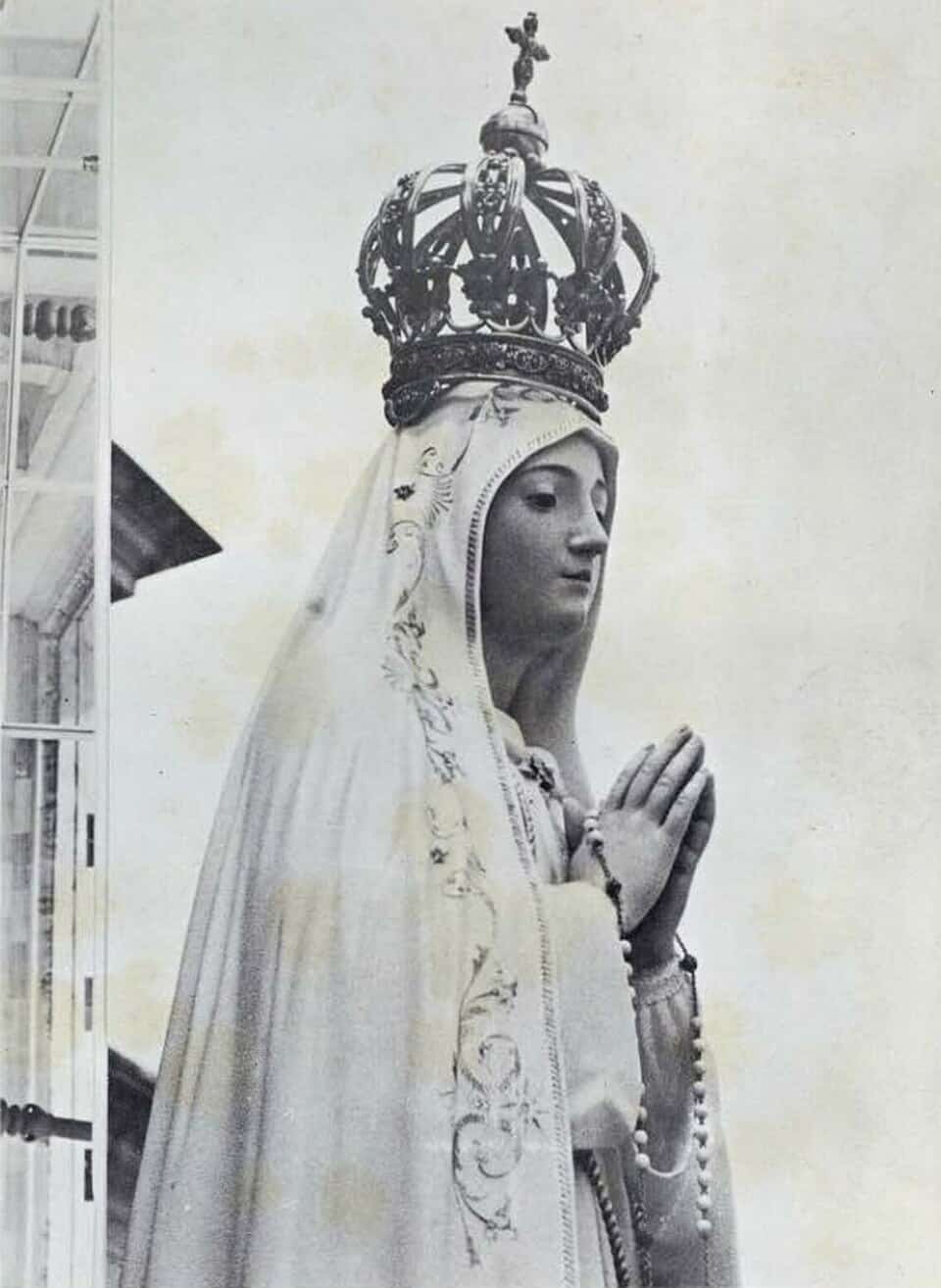
John Paul II personally connected the vision to the assassination attempt against him in St. Peter’s Square on May 13, 1981, exactly sixty four years after the first apparition. A gunman shot him at close range. He survived, later attributed his survival to Our Lady of Fatima’s intercession, and donated the bullet removed from his body to the shrine at Fatima where it was set into the crown of the statue. Benedict XVI wrote that John Paul II was personally convinced that Mary had diverted the bullet that might have killed him.
The Church presents this as John Paul II’s own spiritual interpretation, held with deep personal conviction and entirely consistent with Catholic belief in the intercession of the saints.
The Consecration Question and the Speculation
What Mary Asked and What the Church Concluded
Mary’s request, as conveyed through Lucia, was that the Pope consecrate Russia to her Immaculate Heart in union with the bishops of the world. Several popes made consecration acts in the decades that followed. Pius XII consecrated the world to the Immaculate Heart of Mary in 1942 with a specific reference to the peoples of Russia. Paul VI renewed the act during the Second Vatican Council. John Paul II made a consecration in 1982 but afterward acknowledged it had not been made in full union with the world’s bishops as requested.
He tried again on March 25, 1984, in St. Peter’s Square, in a public act made in union with bishops around the world who had been invited to join him.
The question of whether the 1984 act fulfilled Our Lady’s request was answered not by theologians or commentators but by Sister Lucia herself. The Congregation for the Doctrine of the Faith, in its 2000 document, reported her confirmation directly:
“Sister Lucia personally confirmed… ‘Yes, it has been done just as Our Lady asked, on 25 March 1984.’ Hence any further discussion or request is without basis.”
That is a strong statement from the Church’s doctrinal office. The consecration was made. The person best positioned to evaluate whether it fulfilled the request confirmed that it did.
Pope Francis consecrated Russia and Ukraine to the Immaculate Heart of Mary on March 25, 2022, in union with bishops around the world, in the context of the war in Ukraine. Sister Lucia’s confirmation of the 1984 act stands, and the Church has not reversed or qualified that conclusion. Francis’s act can be understood as a further entrustment of those nations to Mary’s intercession without requiring us to reopen what the Church has already addressed.
On the Speculation
There are Catholics, some of them sincere and devout, who believe that the text published in 2000 is not the complete third secret, that something was withheld, that the real content contains explicit warnings about apostasy within the Church or prophecies so alarming that Rome chose to suppress them. Books have been written. Websites are devoted to it.
The Church’s response comes from Benedict XVI directly. Writing in the context of the 2000 publication, he warned against:
“confused apocalyptic interpretations and speculation… disturbing the faithful rather than inviting them to prayer and penance.”
The purpose of publishing the secret, he wrote, was precisely to dispel the air of mystery that had allowed distorted readings to flourish, and to redirect Catholics toward what Fatima is actually asking of them.
Sister Lucia, who carried the secrets for decades and outlived Francisco and Jacinta by more than eighty years, confirmed the consecration, accepted the Church’s handling of the secrets, and spent the last decades of her life as a Carmelite nun. She did not spend them agitating for the release of hidden documents. That is worth sitting with.
Don’t Lose the Forest for the Trees
There is something clarifying about going back to what we actually know about Mary.
We know that when the angel Gabriel came to her with the most staggering request in human history, she said yes with no reservations, surrendering her entire life to whatever God intended. Let it be done to me according to your word. We know that the last time Mary speaks in Scripture, she is at a wedding in Cana, and she turns to the servants and says simply: do whatever He tells you. That is her last recorded sentence. It is not a prophecy or a secret. It is a direction, and it points away from her and toward her Son.
This is the Mary of Fatima. Not a figure of drama or confusion or insider information parceled out to the properly initiated. A mother who comes to a field in Portugal in the middle of a world war and says to three shepherd children what she has always said: pray, do penance, turn back to God, trust His mercy, and do whatever He tells you.
If the secrets of Fatima are leaving you anxious, if you find yourself spending more energy researching what the Church may or may not have suppressed than you spend on your knees, if Fatima has become a source of suspicion rather than conversion, it is worth asking honestly whether you are looking at the right thing. Mary did not come to Cova da Iria to generate a cottage industry of apocalyptic theorizing. She came because souls were in danger and the world was at war and she wanted her children to pray.
Pope John Paul II summarized the message plainly. He said it consists in an exhortation to conversion, prayer especially the Rosary, and reparation for sins. He said it flows from the Gospel and quoted Mark 1:15 as its root: repent and believe in the Good News. That is Fatima. Everything else, the secrets, the visions, the debates about consecrations, the questions about hidden texts, is either an explanation of that call or a distraction from it.
Fatima is worth taking seriously precisely because it leads somewhere. It leads to the Rosary, to Confession, to the Eucharist, to penance, to a life more fully given over to God. If your engagement with it is producing fear and division and a hunger for knowledge that feels more like conspiracy than faith, the fix is not more research. The fix is what Mary asked for in May 1917 and kept asking for every month until October.
She is not the destination. She is standing in a field, and she is pointing.


You May Also Like

Let the Heart Lead: Escaping Overthinking in the Catholic Spiritual Life
Pray for Them Anyway