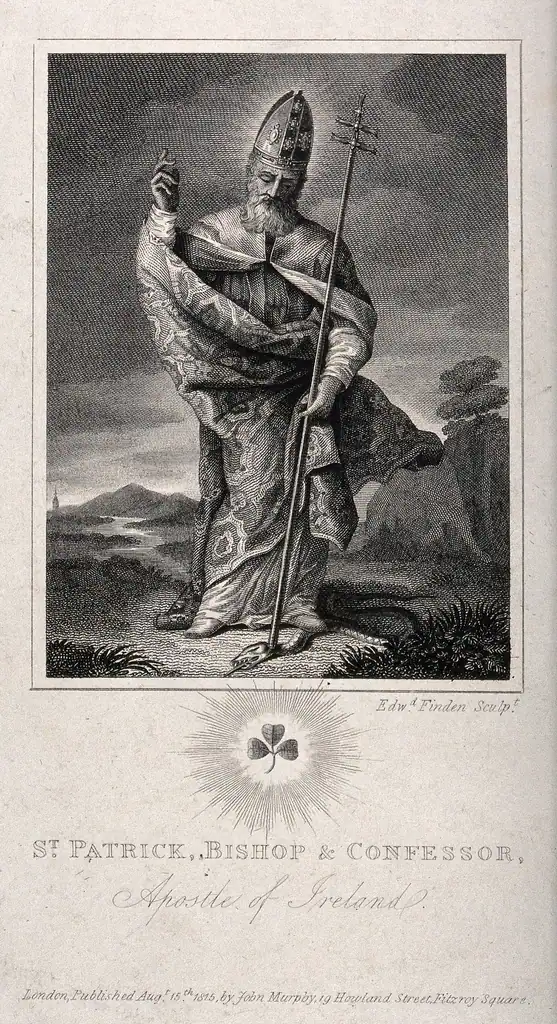
The Saint Behind the Shamrock: Who St. Patrick Actually Was
He was kidnapped as a teenager, spent six years as a slave, and escaped against all odds. Then he went back. This is the Patrick worth knowing.
More Than a Holiday
Every year on March 17, millions of people wear green, raise a glass, and celebrate a man most of them know almost nothing about.
St. Patrick (c. 385–461 AD) has become so thoroughly wrapped in cultural tradition—the shamrocks, the parades, the rivers dyed green—that the actual person has largely disappeared beneath it. Which is a shame. Because the real Patrick is more interesting than any of it.
He was not Irish by birth. He did not drive out literal snakes. The shamrock story appears nowhere in his own writings. What he left behind instead is something rarer: two short documents written in his own hand, in rough and humble Latin, that read less like hagiography and more like a confession spoken directly to God.
His life speaks with particular force to anyone who has ever suffered without explanation, doubted whether God was listening, or been asked to return somewhere they would rather forget. That is the Patrick worth knowing.
Kidnapped: The Crucible of Faith
He was around sixteen years old when they took him.
Patrick was born in Roman Britain into a Christian family of some standing—his father was a deacon, his grandfather a priest. By his own admission, his faith at that age was nominal at best. He had heard the Gospel. He had not yet felt it.
Then Irish raiders came.
He was taken across the sea and put to work herding sheep—alone, exposed to the elements, far from everyone he knew. In the Confessio, the autobiographical account he would write decades later, he does not linger on bitterness. What he records is what happened to him inwardly:
“More and more did the love of God, and my fear of him and faith increase, and my spirit was moved so that in a single day I would say as many as a hundred prayers and almost as many in the night.”
A hundred prayers a day. In the cold, on the hills, with no one watching. Not the prayers of a man performing religion—the prayers of a man who had found, in total desolation, that God was actually there.
This is the pattern the Church has recognized in the saints across every century: suffering, when surrendered rather than merely endured, becomes a school. Not a school that teaches us to be numb, but one that strips away everything we were leaning on that was not God—until we discover, sometimes to our great surprise, that God is enough.
That is the education that produced the man who would eventually convert a nation. It did not begin with a seminary. It began with loss.
The Escape—and the Dream
After six years, the voice came at night.
“You have fasted well. Very soon you will return to your native country. Behold, your ship is ready.”
He had no ship. He had no money, no contacts, no plan. The ship the voice described was two hundred miles away. And yet he went—on foot, across unfamiliar terrain, trusting a dream.
When he reached the coast, the crew—pagans transporting Irish hounds—initially refused him passage. He walked away and began to pray. Before he had finished, a sailor called him back.
What followed was not triumphant. The crew came ashore in a devastated region and wandered for twenty-eight days with nothing to eat. When the captain challenged Patrick—your God is supposed to be great, do something—Patrick told him to pray sincerely. Shortly after, a herd of pigs appeared on the road.
He records these details not to impress but to document something he found astonishing: that God had not simply spoken to him in a dream, but had followed him into the chaos afterward. Providence, for Patrick, was not a theological concept. It was a travel companion.
He eventually made it home to Britain. His family received him warmly and begged him never to leave again.
He would not stay long.
The Call Back
The dream that changed everything came not long after his return.
Patrick describes a vision in which a man named Victoricus arrived from Ireland carrying letters. He took one and began to read it. The heading read: “The Voice of the Irish.” And then:
“I imagined that in that moment I heard the voice of those who were beside the wood of Foclut… and they cried out as with one voice: ‘We beg you, holy youth, to come and walk among us once more.’”
He woke broken-hearted.
These were not voices calling him to a comfortable posting. They were the voices of the people who had enslaved him—or people like them. The same island. The same culture. The people whose raids had stolen six years of his life.
And his response was not resentment. It was grief that he could not get there fast enough.
Patrick’s return to Ireland was not the adventure of a bold missionary seeking glory. It was the response of a man so transformed by suffering and prayer that love had genuinely replaced whatever bitterness might have taken root.
The Mission
It is worth noting that Rome had already tried. A missionary named Palladius had been sent to Ireland by Pope Celestine I around 431 AD—tasked with serving the Irish Christians already there—and the mission collapsed. Patrick landed the following year, around 432 or 433, and where Palladius had not prevailed, Patrick took hold and did not let go.
What followed was roughly thirty years of relentless work: baptizing thousands in the name of the Father, Son, and Holy Spirit, ordaining local clergy, founding churches, and establishing Armagh as the primatial see that would anchor Irish Christianity for centuries. He mentions in the Confessio twelve occasions on which he was taken captive. He was opposed by druids, challenged by kings, and at one point had a formal accusation brought against him by fellow Christians in Britain—based on a sin he had confessed to a friend decades earlier—that nearly derailed his entire mission.
His response is consistent throughout: “I have cast myself into the hands of Almighty God.” Not resignation—settled confidence.
The Epistola ad Coroticum shows a fiercer edge. When a British warlord raided a group of Patrick’s newly baptized converts—killing some, selling others into slavery—Patrick wrote a furious letter demanding their return and excommunicating Coroticus and his soldiers. The man who had himself been a slave did not theorize about human dignity. He fought for it.
The Easter Fire
The setting was Holy Saturday, around 433 AD. High King Laoghaire had decreed that no fire was to be lit until he had lit the ceremonial flame at Tara—a ritual with deep pagan religious significance. To violate it was a direct challenge to the spiritual order the king represented.
Patrick climbed the hill of Slane, overlooking Tara across the valley, and lit the Paschal fire.
The king could see it from his hall. Druids warned him that if the fire was not extinguished that night, it would burn in Ireland forever. Laoghaire rode out with soldiers to confront Patrick directly. The standoff ended not with Patrick’s execution but with the king granting him permission to preach freely throughout Ireland.
Whether every detail is historically precise matters less than what the moment represents: the light of the Resurrection carried openly into the heart of Irish paganism, held there against the full weight of earthly power. The Easter Vigil, still celebrated each year with the lighting of the Paschal candle, carries exactly this symbolism. Christ is the light that darkness cannot overcome. Patrick enacted that truth on a hillside in the dark.
His prayer captures the confidence behind it:
“I arise today through the strength of heaven… Christ with me, Christ before me, Christ behind me, Christ in me.”
A man who prays like that does not need the darkness to cooperate.
The Shamrock: Legend, Truth, and the Trinity
Here is the honest account: there is no shamrock in Patrick’s writings. None. The story of him plucking a trefoil to explain the Trinity does not appear in any source until centuries after his death. It is a later tradition—pious, charming, and almost certainly invented.
This is worth saying clearly, not to diminish the legend, but because the truth is more interesting.
The real Patrick did not need a visual aid to teach the Trinity. He was saturated in it. The prayer attributed to him—the Breastplate—begins with one of the most direct Trinitarian invocations in early Christian literature:
“I arise today through a mighty strength, the invocation of the Trinity, through belief in the Threeness, through confession of the Oneness of the Creator of creation.”
This is not a man reaching for a clover to explain something puzzling. This is a man for whom the Trinity was the air he breathed.
Why the Trinity Is Hard to Explain
The Church has always acknowledged the difficulty. The Catechism calls the Trinity “the central mystery of Christian faith and life”—a mystery that “cannot be known unless revealed by God.” One God in three Persons: Father, Son, and Holy Spirit. Not three gods. Not one God wearing three masks. Three distinct Persons sharing one divine nature, co-equal and co-eternal.
Every analogy falls short. The shamrock has three leaves but one plant—a reasonable start, but it risks implying that the Persons are merely parts of God rather than each being fully God. St. Augustine spent fifteen years on the Trinity and concluded the mystery exceeded his grasp.
Patrick did not resolve it. He proclaimed it—to people who had no framework for it—because he had encountered the living God in prayer and knew the Trinity was not primarily a puzzle to be solved but a reality to be inhabited.
The shamrock, even if legendary, points toward something real: Patrick’s instinct to meet people where they were, to use the ordinary world as a doorway into the extraordinary. He did not import a foreign religion and demand conformity. He found in the Irish soul a place where the Gospel could take root. And take root it did.
His Writings: The Man in His Own Words
Patrick left behind two texts scholars broadly agree are authentically his: the Confessio and the Epistola ad Coroticum. Together they run to perhaps forty pages. Most people will never read them. That is a loss worth correcting.
The Confessio is not a triumph narrative. It is an old man’s account of his own unworthiness—written partly to defend himself against accusations, partly as an act of praise to a God he cannot stop marveling at. The Latin is rough; Patrick apologizes for this repeatedly, noting that his education was interrupted at sixteen and never fully recovered. But the roughness is part of what makes it compelling. This is not polished theology. It is lived testimony.
He describes himself as “a stone lying in deep mire”—and then immediately pivots to gratitude that God lifted even that stone and placed it at the top of the wall. The humility is structural, not rhetorical. It is the humility of a man who has watched God work through him for thirty years and remains genuinely astonished that he was the instrument chosen.
In an age saturated with personal branding and curated self-presentation, here is a man who had converted a nation and still wrote something that reads like a conversation between a tired old bishop and the God who never let him go.
The Confessio is available in full translation online, free, and readable in a single sitting. You will not find shamrocks or snakes. You will find something better: a human being, imperfect and astonished, bearing witness to a God who is faithful.
A Life Worth Imitating
Patrick did not set out to be a saint. He set out to survive.
At no point in the Confessio does he describe himself as heroic. He describes himself as carried—moved by a God he did not fully understand toward purposes that repeatedly exceeded his own courage. The mission was not his idea. The strength was not his own. Even the forgiveness he extended toward the Irish was not manufactured from some natural reservoir of generosity. It was worked into him, slowly, over years of prayer in conditions he would never have chosen.
His Legacy
The Ireland Patrick left behind became something no one could have predicted. Within a century of his death, Irish monasteries were producing scholars, illuminating manuscripts, and sending missionaries back into a Europe darkened by the collapse of Rome. The island he had evangelized against all odds became, in the phrase that has followed it ever since, the Isle of Saints and Scholars. He died around 461 AD and was buried at Saul, near Strangford Lough, where he had built his first church. Patrick did not live to see what Ireland became. He planted; others harvested.
The Prayer for Every Day
The Breastplate—whether composed by Patrick or in his spirit—is worth praying not as a historical curiosity but as a daily act of orientation:
Christ with me, Christ before me, Christ behind me,
Christ in me, Christ beneath me, Christ above me,
Christ on my right, Christ on my left,
Christ when I lie down, Christ when I sit down, Christ when I arise,
Christ in the heart of every man who thinks of me,
Christ in the mouth of everyone who speaks of me,
Christ in every eye that sees me,
Christ in every ear that hears me.
This is not a prayer asking God to make life easier. It is a prayer asking God to fill every direction—every moment, every encounter, every vulnerability—with his presence.
His feast day is March 17. But his lesson is not seasonal. It belongs to every ordinary person who has ever suffered without understanding why, prayed without certainty of being heard, and been asked to do something that seemed far beyond them.
God uses the unlikely. God follows the faithful into the wilderness. God takes the stone lying in the deep mire and places it, somehow, at the top of the wall.
Patrick knew this not because he read it somewhere. He lived it—and left behind just enough words to make sure we could know it too.


You May Also Like
St. Joseph: Silent Strength in a Noisy World
He Has Been Here the Whole Time: An Introduction to the Holy Spirit