Divine Mercy Sunday: What It Is, How to Celebrate It, and Why It Matters
There is a moment, perhaps in the quiet of a difficult night or in the weight of a long-carried guilt, when the soul asks a desperate question: Can God truly forgive me? Divine Mercy Sunday exists, in part, as Heaven’s answer to that question — a resounding, tender, and unconditional yes.
Celebrated every year on the Second Sunday of Easter, Divine Mercy Sunday is one of the most spiritually powerful feasts in the Catholic Church’s liturgical calendar. It is a day when the floodgates of God’s grace are opened wider than at any other time of the year — a day when Jesus Christ, who died and rose for every soul, extends His mercy without limit to all who approach Him with trust.
“Humanity will never find peace until it turns with trust to Divine Mercy.”
— Jesus Christ to St. Faustina Kowalska, Diary
This guide will walk you through everything you need to know: where this feast came from, what the Church teaches, how to participate fully, what promises Jesus made, and how to make Divine Mercy not just a single feast day but a way of life.
The Origins of Divine Mercy Sunday
St. Faustina: The Secretary of Divine Mercy
The story of Divine Mercy Sunday begins in 1930s Poland, in the heart of a young nun named St. Maria Faustina Kowalska (1905–1938). Born Helena Kowalska to a poor farming family, she entered religious life with little education but an extraordinary interior life. Jesus chose her, in His words, as the “secretary and apostle of His mercy” — the instrument through which He would reveal His mercy to a world on the brink of catastrophe.
In her profound spiritual diary — now published as Divine Mercy in My Soul — St. Faustina recorded her visions, conversations with Jesus, and the specific devotions He asked her to spread. These included the Image of Divine Mercy, the Chaplet of Divine Mercy, the Hour of Mercy at 3 p.m., and above all, a special Feast of Mercy to be celebrated on the first Sunday after Easter.
Jesus told her with unmistakable urgency: “I desire that the Feast of Mercy be a refuge and shelter for all souls, and especially for poor sinners. On that day the very depths of My tender mercy are open. I pour out a whole ocean of graces upon those souls who approach the fount of My mercy.”
From Suppression to Universal Feast
After St. Faustina’s death in 1938, the devotion she carried faced a difficult road. Vatican authorities temporarily suppressed the spread of the devotion in the 1950s due to concerns about theological nuance and translation accuracy. For a time, it seemed the message might be silenced.
But God’s mercy cannot be suppressed forever.
A Polish bishop who had known Faustina personally — Karol Wojtyla — helped reopen the investigation into her writings. When that bishop became Pope John Paul II, he brought Divine Mercy to the world stage. He beatified Faustina in 1993, and on April 30, 2000, he canonized her as the first saint of the new millennium — simultaneously designating the Second Sunday of Easter as Divine Mercy Sunday for the entire universal Church. At last, the feast Jesus had asked for was given to the world.
“This is the happiest day of my life — to give back to the world the message of mercy.”
— Pope John Paul II, Canonization of St. Faustina, April 30, 2000
In 2002, St. John Paul II dedicated the Shrine of Divine Mercy in Kraków-Łagiewniki, Poland — the very place where Faustina had lived and where her body rests. He entrusted the entire world to Divine Mercy and prophesied that from this place, a “spark” of renewal would go out to prepare the world for Christ’s return.
The Liturgical Meaning of This Feast
Divine Mercy Sunday does not stand alone — it crowns the Easter Octave, the eight days in which the Church celebrates the Resurrection as if it were one great, unending day of joy. The Directory on Popular Piety and the Liturgy calls Divine Mercy Sunday the “natural locus” for humanity to accept the mercy of the Redeemer, noting that “the paschal Christ is the definitive incarnation of mercy.”
In other words: the Resurrection is mercy made flesh. God’s answer to the worst that sin and death could do was not wrath — it was an empty tomb and a risen Lord who says, “Peace be with you.”
Mass Readings for Divine Mercy Sunday
The readings assigned to this feast day form a beautiful arc — from the early Church living mercy together, to personal faith tested and transformed:
- Acts 2:42–47 — The early Christian community devoted themselves to the apostles’ teaching, the breaking of bread, and prayer. They shared everything, and the Lord added to their number daily. A portrait of mercy lived in community — giving, sharing, welcoming.
- Psalm 118:2–4, 13–15, 22–24 — “His steadfast love endures forever.” The rejected stone becomes the cornerstone. “This is the day the Lord has made; let us rejoice and be glad in it.”
- 1 Peter 1:3–9 — We are born into a “living hope” through the Resurrection, guarded by God’s power through faith. Though we face trials, we rejoice with unspeakable joy — for we are receiving the salvation of our souls.
- John 20:19–31 — The risen Jesus appears to frightened disciples, breathes the Holy Spirit upon them, and grants authority to forgive sins. Thomas declares “My Lord and my God!” Jesus blesses all who believe without seeing — including us.
Notice that in the Gospel, the first gift of the Risen Christ is peace, and the second is the power to forgive sins. Divine Mercy Sunday is rooted not in sentiment, but in the very authority Jesus gave His Church at Easter.
How to Celebrate Divine Mercy Sunday
Jesus gave St. Faustina specific conditions for receiving the extraordinary graces of Divine Mercy Sunday. These are not magic formulas but invitations to open the soul completely to God’s love. Here is how to celebrate the feast fully:
1. Go to Confession
Jesus asked for a sincere confession — not necessarily on the day itself, but in preparation for it. This is a moment of profound reconciliation. No sin is too great, no past too dark. Confession is the doorway through which mercy flows.
2. Receive Holy Communion on Divine Mercy Sunday
Approach the Eucharist with a heart full of trust. Jesus promised that the soul who receives Communion on this day with the right dispositions will receive the complete forgiveness of sins and temporal punishment — a grace equal to Baptism itself.
3. Venerate the Image of Divine Mercy
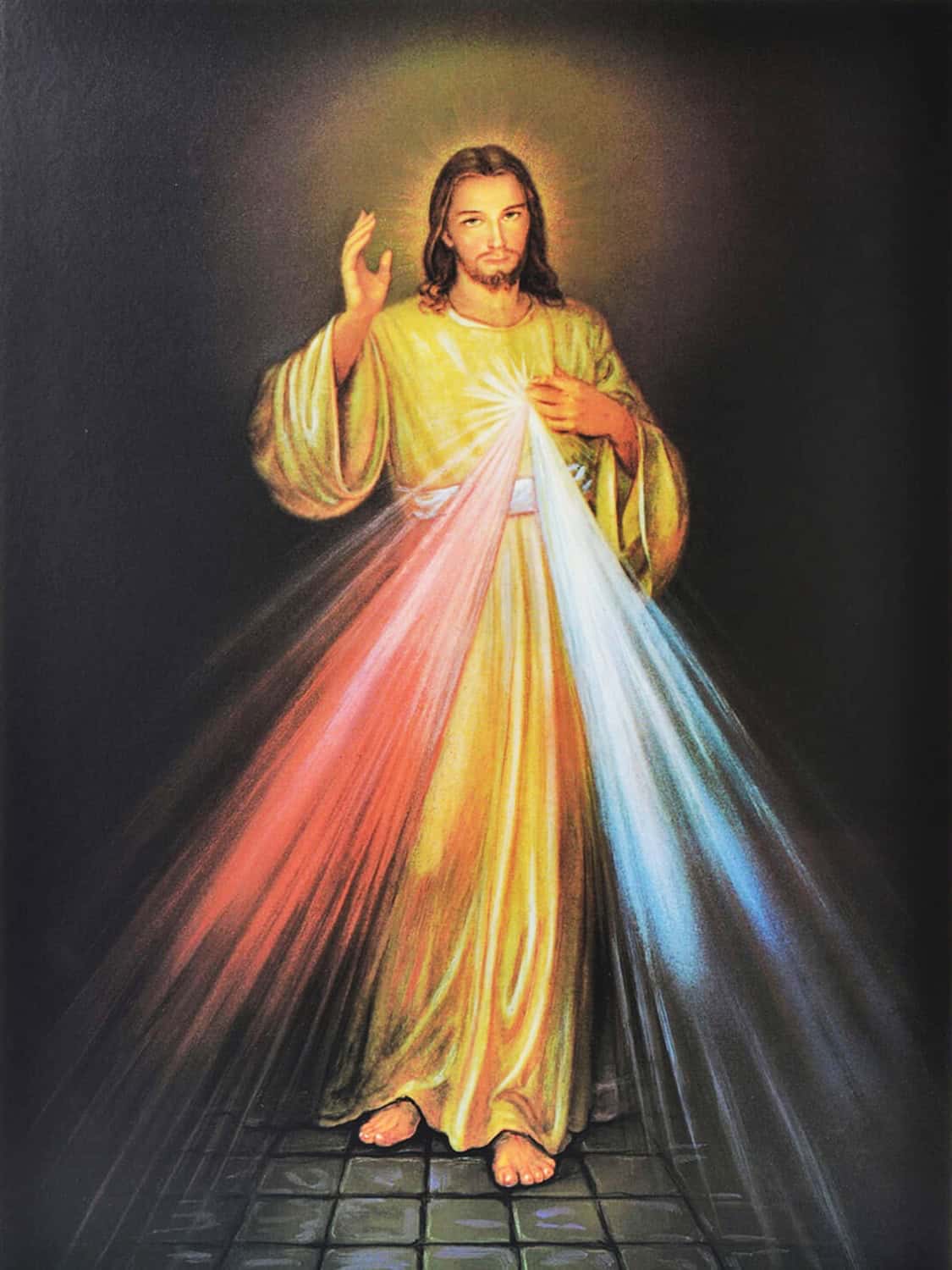
The image shows Jesus with two rays — one red (for the blood), one pale (for the water) — flowing from His Heart. These symbolize the Sacraments of Baptism and Eucharist. Praying before this image with trust opens the soul to the graces it represents.
4. Pray the Chaplet of Divine Mercy
Prayed on ordinary rosary beads, the Chaplet offers the Body, Blood, Soul, and Divinity of Jesus to the Father as atonement for sin. It can be prayed privately or in community, and ideally at the 3 p.m. Hour of Mercy.
5. Practice Mercy Toward Others
Jesus made clear that those who receive mercy must give it. This means acts of charity, words of kindness, forgiveness offered to those who have hurt us. The feast is not complete without extending to others what we have received from God.
How to Pray the Chaplet of Divine Mercy
The Chaplet of Divine Mercy is prayed on standard rosary beads in five decades:
Opening: Begin with the Our Father, Hail Mary, and Apostles’ Creed.
On the Our Father beads:
“Eternal Father, I offer You the Body and Blood, Soul and Divinity of Your dearly beloved Son, Our Lord Jesus Christ, in atonement for our sins and those of the whole world.”
On the Hail Mary beads (10 per decade):
“For the sake of His sorrowful Passion, have mercy on us and on the whole world.”
Conclude (3 times):
“Holy God, Holy Mighty One, Holy Immortal One, have mercy on us and on the whole world.”
The Promises of Divine Mercy Sunday
Jesus made extraordinary promises to St. Faustina regarding this feast — promises bound not to human merit, but to trust. He said the soul who approaches Him with sincere trust will not be turned away:
- Complete Forgiveness — Full remission of sins and their temporal punishment — a grace “as great as Baptism” — for those who go to Confession and receive Communion with trust.
- An Ocean of Grace — “I pour out a whole ocean of graces upon those souls who approach the fount of My mercy.” The feast is described as the greatest outpouring of God’s grace in the Church year.
- Protection from Evil — Souls who venerate the image will not perish. Jesus promised protection especially at the hour of death.
- Refuge for Hardened Sinners — The feast is intended especially for those who feel farthest from God: “a refuge and shelter for all souls, and especially for poor sinners.”
“There is no human misery that could measure up to My mercy.”
— Jesus Christ to St. Faustina, Diary
These promises flow from a single, radical truth: God’s mercy is greater than our sin. The condition is not perfection — it is trust. “Jesus, I trust in You” (Jezu, ufam tobie) is the prayer that unlocks Heaven’s mercy.
The Key Devotions of Divine Mercy
The Divine Mercy Image
At Jesus’ instruction, St. Faustina asked a painter to create an image of Jesus as she had seen Him — radiant white, with His right hand raised in blessing and two rays streaming from His Heart: one red, one pale. Beneath the image appear the words: “Jesus, I trust in You.”
Jesus told Faustina: “By means of this Image I shall grant many graces to souls; it is to be a reminder of the demands of My mercy, because even the strongest faith is of no avail without works.”
The Hour of Mercy — 3:00 p.m.
Every day at 3 in the afternoon, the Church recalls the hour Christ died on the Cross — the moment when mercy and love poured out from His pierced Heart. Jesus asked St. Faustina to pray especially at this hour and promised extraordinary graces to those who do so with faith. Even a brief prayer — “You died for me, Lord; have mercy on me” — honors this sacred hour.
The Novena Before the Feast
Jesus asked St. Faustina to begin a novena on Good Friday, praying for nine days leading into Divine Mercy Sunday. Each day, He gave her a different group of souls to bring before His mercy — sinners, priests, the faithful, non-believers, those in purgatory, children, and more. Praying this novena is a powerful way to enter fully into the spirit of the feast.
Living Divine Mercy Beyond the Feast
Divine Mercy Sunday is a beginning, not an end. Pope John Paul II called it the “Easter gift for the third millennium” — not a single annual event but a way of seeing and living. Pope Francis has echoed this, inviting all Catholics to bring their failures and failings to Jesus, just as Faustina did, and experience mercy anew each day.
St. John Paul II wrote in his encyclical Dives in Misericordia: “Man not only receives and experiences the mercy of God, but is also called to practise mercy towards others.” The feast thus carries a mandate — go and do likewise. Visit the lonely. Forgive the unforgiving. Give without counting the cost.
In a world marked by division, war, injustice, and despair, the message of Divine Mercy is not pious escapism — it is a revolutionary act of trust. Every Chaplet prayed, every act of kindness offered, every confession entered sends a ripple of grace outward into a world that desperately needs it.
Daily Practices: Pray the Chaplet of Divine Mercy each day, especially at 3 p.m. Pray before the Divine Mercy image. Perform at least one act of mercy — a deed, a word, or a prayer — for another person every day.
Frequently Asked Questions About Divine Mercy Sunday
What is Divine Mercy Sunday?
Divine Mercy Sunday is a feast of the Catholic Church celebrated on the Second Sunday of Easter — the Sunday immediately after Easter Sunday. Instituted by Pope John Paul II in 2000, it commemorates the infinite mercy of God revealed through the Passion, Death, and Resurrection of Jesus Christ. It is rooted in the apparitions and writings of St. Faustina Kowalska, a Polish nun to whom Jesus appeared with a message of mercy for the whole world.
When is Divine Mercy Sunday?
Divine Mercy Sunday falls on the Second Sunday of Easter — the Sunday immediately following Easter Sunday. Because Easter is a moveable feast, the date changes every year, typically landing somewhere between late March and late April. To find the date for the current year, simply look up when Easter falls and count one Sunday forward.
What are the conditions to receive the special graces of Divine Mercy Sunday?
Jesus gave St. Faustina three conditions: (1) Confession — go to the Sacrament of Reconciliation in preparation for the feast; (2) Holy Communion — receive the Eucharist on Divine Mercy Sunday with a heart full of trust; (3) Works of Mercy — extend mercy to others through deeds, words, or prayer. Those who fulfill these conditions with sincere trust receive the complete forgiveness of sins and temporal punishment — a grace Jesus described as equal to that received at Baptism.
Who was St. Faustina Kowalska?
St. Maria Faustina Kowalska (1905–1938) was a Polish nun of the Congregation of the Sisters of Our Lady of Mercy. She experienced extraordinary mystical encounters with Jesus Christ, which she recorded in her Diary: Divine Mercy in My Soul. Jesus chose her as the instrument to bring His message of mercy to the world. She was canonized by Pope John Paul II on April 30, 2000 — the same day Divine Mercy Sunday was established as a universal feast. She is sometimes called the “Apostle of Divine Mercy.”
How do you pray the Chaplet of Divine Mercy?
The Chaplet is prayed on standard rosary beads. Begin with the Our Father, Hail Mary, and Apostles’ Creed. On the Our Father beads pray: “Eternal Father, I offer You the Body and Blood, Soul and Divinity of Your dearly beloved Son, Our Lord Jesus Christ, in atonement for our sins and those of the whole world.” On each Hail Mary bead pray: “For the sake of His sorrowful Passion, have mercy on us and on the whole world.” Conclude three times: “Holy God, Holy Mighty One, Holy Immortal One, have mercy on us and on the whole world.”
What is the Hour of Mercy?
The Hour of Mercy is 3:00 p.m. each day — the hour at which Jesus died on the Cross. Jesus asked St. Faustina to pray especially at this hour and promised special graces for those who do so, particularly for sinners. Even a brief, heartfelt prayer at this time honors the moment of Christ’s greatest act of mercy.
What is the Divine Mercy Image and what do the rays mean?
The Divine Mercy Image depicts Jesus in white garments with two rays streaming from His Heart: one red and one pale. Jesus explained: “The pale ray stands for the Water which makes souls righteous. The red ray stands for the Blood which is the life of souls.” These correspond to Baptism (water) and the Eucharist (blood). The words “Jesus, I trust in You” appear at the bottom. Jesus promised that the soul who venerates this image with trust would not perish.
Is the Divine Mercy devotion approved by the Catholic Church?
Yes, fully and enthusiastically. The devotion was formally approved at the canonization of St. Faustina Kowalska in 2000 by Pope John Paul II, who on that same day established Divine Mercy Sunday as a feast for the entire universal Church. It has been affirmed by Popes Benedict XVI and Francis, and is among the most widely practiced Catholic devotions in the world today.
“Jesus, I trust in You.” — Jezu, ufam tobie.
Misericordias Domini in aeternum cantabo — “I will sing of the mercies of the Lord forever.” (Ps 89:2)


You May Also Like

Jesus in the Home: The Nazareth Years We Overlook
Can We Afford to Live Differently?