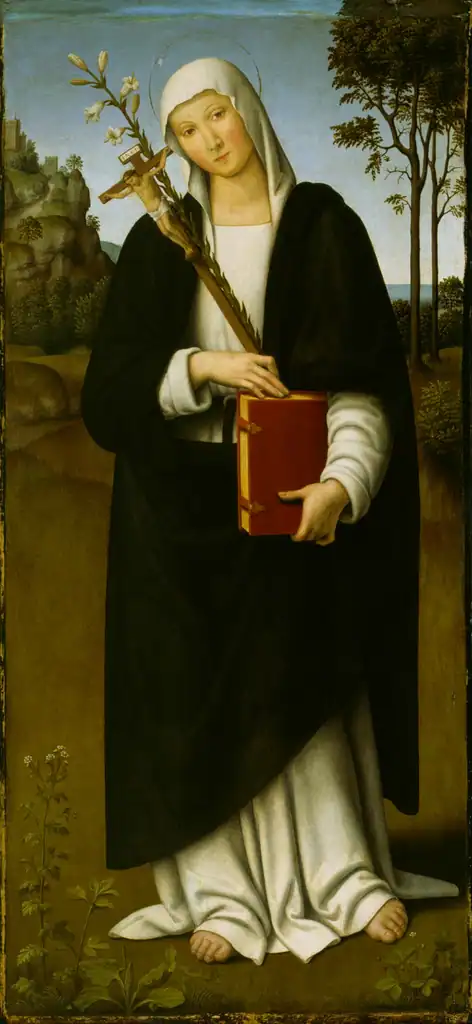
The Woman Who Told the Pope to Come Home: The Life and Mind of St. Catherine of Siena
She had no formal education, no political office, and no institutional authority. Popes listened anyway.
St. Catherine of Siena Virgin and Doctor of the Church
Feast Day: April 29
Born: 1347, Siena, Italy Died: April 29, 1380, Rome, age 33
Canonized: June 29, 1461 by Pope Pius II
Doctor of the Church: October 4, 1970 by Pope Paul VI
Co-Patroness of Europe: October 1, 1999 by Pope John Paul II
Patron of: Italy, nurses, the sick, and those ridiculed for their piety
Invoked against: fires, miscarriages, and temptations
A Saint Worth Taking Seriously
In 1376, a young Italian woman with no formal education, no political office, and no institutional authority wrote a letter to the Pope telling him to stop being afraid and come home to Rome.
He came.
That single fact is worth sitting with before anything else about St. Catherine of Siena is said. Gregory XI had been living in Avignon for years, as his predecessors had for decades before him. The French cardinals were comfortable there. The political pressures to stay were considerable. And a twenty-nine year old Dominican tertiary from Siena — the twenty-third of twenty-five children, a woman who had taught herself to read as an adult — wrote him letters until he acted on the vow his own conscience had already made.
She was not the only voice urging his return. But she was among the most persistent — and the most effective.
Catherine of Siena (1347–1380) lived only thirty-three years. In that time she nursed plague victims, reconciled warring city-states, guided a circle of disciples that included priests and nobles, dictated one of the great mystical texts of the medieval Church, and wrote nearly four hundred letters to some of the most powerful figures in Europe. She was declared a Doctor of the Church in 1970 — only the second woman in history to receive that title — and Co-Patroness of Europe in 1999.
None of it came from position or credential. All of it came from prayer — and from what prayer, taken seriously enough, produces in a human soul.
Her life is a masterclass in what holiness actually looks like when it is total. Not holiness as niceness, or holiness as piety performed for others, but holiness as the complete reorientation of a life around God — and the strange, surprising power that follows from that reorientation.
The Interior Cell — How Catherine Was Formed
She was born in 1347, the twenty-third of twenty-five children — born a twin, though her sister Giovanna died in infancy — in the dyers’ quarter of Siena. From childhood she displayed an intensity of religious experience that her family found alternately inspiring and inconvenient. She had her first vision of Christ at around age six. By her early teens she had privately vowed her virginity to him, a decision that put her in direct conflict with her family’s plans for her marriage.
When her family tried to break her resolve — removing her private space, burdening her with household work, pressing the case for a suitable husband — Catherine responded with something that would define her entire spiritual life: she built an interior cell.
She could not have solitude outwardly. So she constructed it inwardly. She learned, through sustained practice, to carry a place of prayer within her regardless of the noise and demand around her. Years later she would teach this to others as a foundational principle: the soul must have a cell it can enter at any moment, a place of recollection that external circumstances cannot destroy. It was not an escape from the world. It was the ground from which she engaged it.
At around sixteen she joined the Dominican tertiaries — laywomen affiliated with the Dominican order who lived in the world rather than in a convent. She remained at home, living in a small room, in near-total solitude and austerity for several years. She fasted severely, slept little, and prayed constantly. By her own account these were years of intense spiritual combat as well as deep consolation.
When she was around twenty, Christ appeared to her and placed a ring on her finger — an invisible ring, visible only to herself — as a sign of mystical espousals. The image is striking: not Catherine reaching toward God, but God reaching toward her, claiming her, drawing her into an intimacy that would be the source of everything that followed. Her entire apostolic life flows from this posture of receptivity. She did not manufacture her influence. She received it, and then spent it entirely on others.
The movement outward began with the plague.
Siena suffered devastating outbreaks in Catherine’s lifetime, as it had throughout the mid-fourteenth century. While others fled, Catherine went into the hospitals. She nursed the sick, bathed wounds, buried the dead with her own hands. People who had admired her piety from a distance now watched her do the unglamorous, exhausting, dangerous work of caring for the dying — and some of them were converted simply by what they saw.
This is the pattern her whole life followed: depth of prayer producing breadth of love. The interior cell was not a retreat from the world. It was the place where she was formed into someone the world actually needed — someone with enough interior stillness to enter chaos without being consumed by it, and enough love to stay when staying was costly.
Speaking Truth to Power
Catherine wrote nearly four hundred letters over the course of her short life. They went to popes and antipopes, to queens and mercenary captains, to cardinals living in comfort and sinners living in despair. They were dictated — she could not write quickly enough herself — to a rotating team of secretaries who struggled to keep up with her. They are warm, direct, theologically precise, and entirely unintimidated by the rank of their recipients.
She addressed Gregory XI as “my sweet babbo” — the Tuscan word for daddy. She called him a coward when he was acting like one. She told him the truth about his cardinals, his court, and his responsibilities, with a familiarity that should have been impertinent and somehow was not.
The Avignon Papacy
Since 1309, the papacy had resided not in Rome but in Avignon, in what is now southern France. What had begun as a temporary arrangement under French political pressure had hardened over seven decades into something that looked, to many faithful Catholics, like a captivity. The popes in Avignon were not heretics — but they were comfortable, politically entangled with the French crown, and increasingly distant from the city that was the heart of the Church. Rome itself was decaying. Italy was fractured. The moral authority of the papacy was eroding.
Catherine was not the first to call for the pope’s return. But she was among the most persistent — and the most effective. Beginning in 1376, she wrote to Gregory XI with a combination of fierce urgency and genuine tenderness unlike almost any other correspondence in Church history. She told him that his hesitation was a scandal. She reminded him of the private vow his own conscience had already made to return to Rome. She told him not to be governed by fear of the men around him.
“Be a man,” she wrote to the Vicar of Christ. “Father, no more war. Come.”
In September 1376, Gregory XI left Avignon. He entered Rome the following January — honoring a vow Catherine had helped him find the courage to keep. She had traveled to meet him along the way, encountering him in Genoa before his arrival in Rome. It was the end of nearly seventy years of exile.
The Western Schism
Gregory XI died in 1378, less than a year after his return. What followed was the Western Schism — one of the most painful crises in the history of the Church. A disputed papal election produced two claimants to the throne of Peter: Urban VI in Rome and an antipope in Avignon. Europe split along political lines, with different kingdoms recognizing different claimants.
Catherine threw herself behind Urban VI without hesitation, writing to cardinals, rulers, and the pope himself urging unity and reform. Her letters from this period are marked by an almost ferocious grief — she loved the Church as a body in agony, and she could not be indifferent to its wounds. She moved to Rome at Urban’s request and spent her final months laboring for reconciliation she would not live to see.
Authority Through Love
What is striking about all of this — and what the historical record consistently emphasizes — is that Catherine held no office. She could not vote in a conclave, sit in a council, or issue a decree. She had no leverage over Gregory XI except the quality of her argument, the depth of her prayer, and the obvious sincerity of her love for him and for the Church he led.
That is precisely why he listened. Men in power are accustomed to being flattered, pressured, and manipulated. Catherine did none of those things. She simply told the truth, in love, from a place of complete self-forgetfulness — and the absence of self-interest made her impossible to dismiss. She wanted nothing for herself. She wanted everything for the Church and for Christ’s vicar within it.
This is not weakness dressed up as virtue. It is a form of authority that the world consistently underestimates and the saints consistently demonstrate.
The Dialogue — Her Theological Vision
In 1378, during a period of intense mystical experience, Catherine dictated a book.
She called it simply her Libro — her book. It has come down to us as the Dialogue of Divine Providence, and it is one of the great works of Christian mystical literature. It was dictated in a state of ecstasy, her secretaries working frantically to transcribe what she spoke aloud while her body remained motionless. She had learned to read as an adult; she wrote with difficulty. But the Dialogue flows with a theological coherence and literary beauty that her own secretaries found astonishing — what Pope Paul VI would later call infused wisdom, knowledge received in prayer and expressed with a clarity that needed no academic credential to be recognized as genuine.
The structure is a conversation: Catherine’s soul presents four petitions to God the Father, and God responds at length — on the nature of the soul, the Church, the priesthood, obedience, prayer, and the spiritual life. The voice of God the Father in the Dialogue is tender, urgent, searching, and occasionally sorrowful. It does not read like a theological treatise. It reads like a father speaking to a daughter he loves and is trying to help understand something vast.
The Bridge
The central image of the Dialogue is the Bridge.
Christ, God explains to Catherine, is the bridge between earth and heaven — a living passage spanning the abyss that sin opened between humanity and God. The bridge has three stairs, corresponding to the feet, the side, and the mouth of Christ crucified: the beginning of the spiritual life in repentance, its deepening in love, and its perfection in peace. To walk the bridge is to walk through Christ — through his wounds, his heart, his very being — toward the Father.
The image is both simple and inexhaustible. What it insists upon is that there is no shortcut. The passage to God runs through Christ, and through Christ crucified specifically. Not around the Cross, not above it — through it.
The Blood of Christ
If the Bridge is the Dialogue’s central image, the Blood of Christ is its animating force. Catherine returns to it with an insistence that can seem overwhelming to modern readers — but which makes complete sense within her vision of salvation. The Blood is the price of redemption, the seal of the covenant, the content of the Eucharist, and the source of the Church’s life. It flows through the sacraments and is offered at every Mass.
God speaks to Catherine in the Dialogue of ministers dispensing this “glorious milk and blood” — nourishing the faithful as a mother nourishes a child, sustaining the mystical body of the Church from within. She wrote to one correspondent with characteristic directness: “Bathe in the Blood of Christ crucified.” She meant it as practical spiritual direction. The Blood of Christ, available in prayer and sacrament, is the specific remedy for the specific wound of sin. Her spirituality is not abstract. It is soaked in the Passion.
Self-Knowledge
Alongside the Blood, Catherine returns constantly to self-knowledge as the indispensable foundation of the spiritual life. Not self-knowledge in the therapeutic sense — not excavating one’s feelings or understanding one’s history — but the knowledge of what the soul actually is before God: created, loved, fallen, redeemed, and utterly dependent.
God tells Catherine in the Dialogue that the soul must dwell in two cells simultaneously: the knowledge of self and the knowledge of God. Neither alone is sufficient. Self-knowledge without God collapses into despair. Knowledge of God without self-knowledge produces a pride that mistakes itself for holiness. Together they form the interior cell she had been building since childhood — the place where the soul is honest about what it is and rests in what God is.
The Church
Catherine’s vision of the Church in the Dialogue is organic, sacramental, and unflinching. She loves the Church as a body — a mystical body animated by Christ’s Blood, fed by the Eucharist, structured by hierarchy, and perpetually in need of interior reform. She grieves over corrupt clergy not with contempt but with the specific grief of someone watching a loved one destroy themselves. The remedy she proposes is never revolt or abandonment — always interior conversion, prayer, and fidelity to Peter’s successor even when Peter’s successor is failing.
“Not with war, but with peace and quiet, with humble and continual prayers, sweats and tears” — that is how the Church is reformed. From within. Through holiness. Through people who love the Church enough to suffer for it rather than simply critique it.
It is, among other things, a remarkably timely vision.
What She Leaves Us
Catherine of Siena is not an easy saint to keep at a comfortable distance. The further you go into her life, the harder it becomes to file her away as an inspiring historical figure and move on. She has a way of turning back toward the reader and asking an uncomfortable question: and you?
The Interior Cell
The interior cell is the most transferable thing she left behind — and the most demanding.
It does not require a religious vocation, a quiet house, or large blocks of uninterrupted time. Catherine developed it while doing laundry and cooking meals for a large family that did not particularly understand her. It is simply the practice of maintaining a place of recollection within — a habit of returning, moment by moment, to the presence of God beneath the noise of whatever is happening on the surface of life.
This is not a technique. It is a disposition, built slowly through prayer, that eventually becomes the default orientation of the soul. Catherine’s contemplative depth was not something she achieved and then deployed in her apostolic work. It was the continuously renewed source from which that work flowed. The letters, the peacemaking, the confrontations with power — none of it would have been possible without the hours of prayer that no one saw.
For anyone trying to live a faithful Catholic life in the middle of ordinary demands — work, family, noise, exhaustion — this is perhaps her most practical gift. You do not have to choose between prayer and action. You have to learn, as she did, that action without prayer is merely activity, and prayer without action is merely sentiment. The two are not in tension. They are a rhythm, and Catherine lived that rhythm more completely than almost anyone in the history of the Church.
Total Self-Gift
The harder gift she leaves is her example of total self-surrender.
Catherine did not manage her life. She did not negotiate with God about how much of herself she was willing to give. She gave everything — her comfort, her health, her preferences, her plans — and she gave it not grimly but with a love that her contemporaries found almost incomprehensible. When she nursed plague victims, she overcame her own revulsion through prayer and then found, on the other side of that struggle, a freedom she could not have reached any other way.
This is the countercultural witness her life offers — not primarily as a statement about gender or society, but as a statement about what a human life is for. The world consistently tells us that the path to significance runs through accumulation: of power, credential, platform, influence. Catherine’s life demonstrates something the saints have always demonstrated and the world consistently refuses to believe: that the path to genuine influence runs through self-emptying. She became impossible to ignore precisely because she wanted nothing for herself.
She was following a pattern she had learned from Mary — the woman who said yes before she understood what the yes would cost, who stood at the foot of the Cross when others had fled, whose authority over the imagination of the Church derives entirely from her total orientation toward her Son. Catherine’s own letters invoke Mary constantly, not as a pious ornament but as the practical model of what the surrendered soul looks like in history. Receptive. Generative. Entirely given over. Fully herself precisely because she was fully His.
Her Death
In early 1380, Catherine had a vision of the Church as a ship of enormous weight pressing down upon her. She accepted it. From that point her health deteriorated rapidly; she suffered what appear to have been strokes, losing the use of her legs. She spent her final weeks in Rome, praying for the Church and for Urban VI, offering what remained of herself with the same deliberateness she had brought to everything else.
She died on April 29, 1380. She was thirty-three years old.
Her last recorded words were an offering: “Father, into your hands I commend my soul and my spirit.” The same words Christ spoke from the Cross. She had spent her life learning to mean them, and at the end she meant them completely.
Doctor, Patron, Mirror
In 1970, Pope Paul VI declared Catherine of Siena a Doctor of the Church — only the second woman in history to receive that title, after Teresa of Ávila. He noted specifically that her doctrine was not the product of formal theological study. She had no university training, no access to the academic institutions that shaped the great male theologians of her era. What she had was infused wisdom — knowledge received in prayer, tested in action, and expressed with a clarity that needed no academic credential to be recognized as genuine.
In 1999, Pope John Paul II named her Co-Patroness of Europe alongside Bridget of Sweden and Edith Stein. The designation was not merely honorific. John Paul II explicitly connected Catherine’s example to Europe’s need — a continent whose Christian roots were eroding, whose political conflicts she had spent her life trying to resolve, and whose future required exactly the kind of witness she had offered: faith that engages the world directly, without fear, without self-interest, and without abandoning the interior life that makes such engagement possible.
These titles matter not as decorations but as the Church’s considered judgment about what Catherine’s life actually was and what it continues to offer. Doctor: her teaching is sound, substantial, and worth learning from. Patron: her intercession is active, her example is formative, and her particular charism speaks to the specific challenges of this moment in history.
What that charism is, finally, is this: she shows us what happens when a soul takes God completely seriously. Not selectively. Not conveniently. Not in the spaces left over after everything else has been attended to — but first, and thoroughly, and at whatever cost.
She did not set out to influence popes or write enduring theology or become a Doctor of the Church. She set out to know Christ, to love him without reservation, and to give him everything she had. The influence, the theology, the titles — all of it followed from that, the way light follows from a flame.
She is, in the end, less an example to admire from a distance than a mirror held up to anyone who calls themselves a Christian. The reflection is uncomfortable. The invitation is clear.
Come. Follow. Give everything.


You May Also Like
When Someone Asks You About Jesus

Fish, Not Scorpions: A Reflection on Good Gifts and Imperfect Parenting
