Our Lady of Lourdes: What Happened in 1858 and Why It Still Matters Today
On February 11, the Church celebrates the Feast of Our Lady of Lourdes, commemorating the 18 Marian apparitions reported by St. Bernadette Soubirous in Lourdes, France, in 1858. During these apparitions, the Blessed Virgin Mary identified herself as “the Immaculate Conception,” called for prayer and penance, and directed attention to a spring that continues to draw pilgrims seeking healing and spiritual renewal.
What began quietly at a rocky grotto would become one of the most significant Marian apparitions in Church history.
What Happened During the Lourdes Apparitions in 1858?
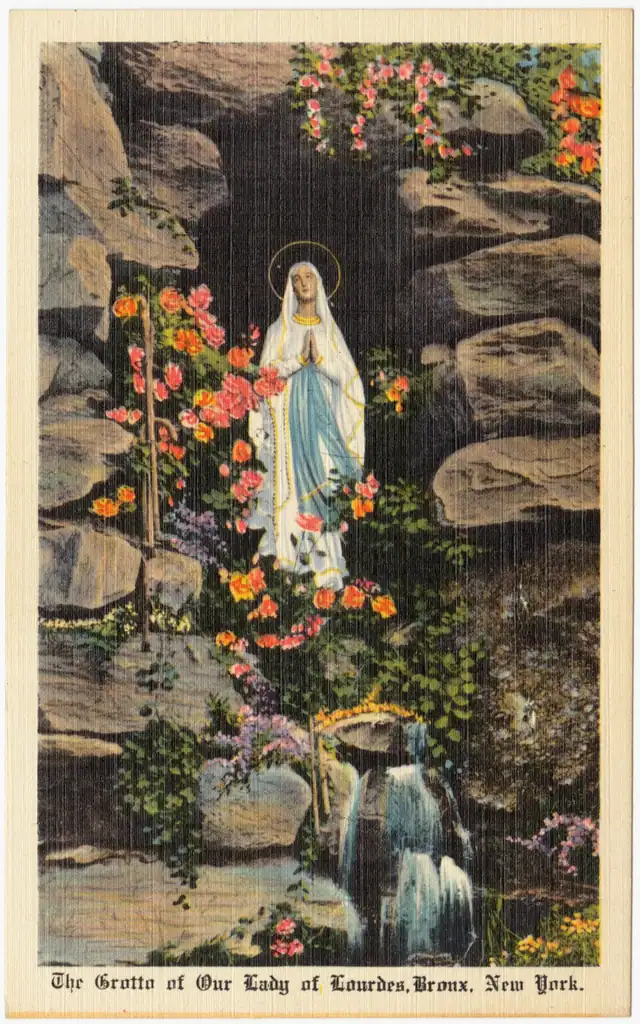
The Lourdes apparitions took place at the Grotto of Massabielle, a rocky outcropping along the Gave River in southern France.
On February 11, 1858, Bernadette had gone with her sister and a friend to gather firewood. While preparing to cross a cold stream, she heard a sound like a gust of wind. Looking toward a niche in the rock, she saw what she later described as a “beautiful lady.”
The Lady wore white, with a blue sash and yellow roses on her feet. She carried a rosary. As Bernadette began to pray, the Lady silently passed the beads through her fingers.
Between February 11 and July 16, 1858, there were 18 apparitions. During these encounters, the Lady:
- Asked for prayer and penance
- Requested that a chapel be built at the site
- Called for processions
- Urged prayer for sinners
On February 25, Bernadette was instructed to drink from and wash in a spring that was not yet visible. She dug into the muddy ground, and water began to flow. That spring continues to run today and has been associated with medically documented healings.
“I Am the Immaculate Conception”
The most significant moment of the Lourdes apparitions came on March 25, the Feast of the Annunciation. When Bernadette repeatedly asked the Lady her name, she replied in the local dialect:
“Que soy era Immaculado Conceptiou.”
“I am the Immaculate Conception.”
Just four years earlier, in 1854, Pope Pius IX had formally defined the dogma of the Immaculate Conception. Bernadette herself did not understand the theological meaning of the phrase she repeated to her parish priest.
This declaration powerfully echoed and reinforced the Church’s Marian teaching — not adding new doctrine, but drawing attention to a truth already proclaimed.
What Does the Immaculate Conception Mean?
The doctrine of the Immaculate Conception teaches that Mary was preserved from original sin from the first moment of her conception, by a singular grace of God, in view of the merits of Jesus Christ.
This teaching does not place Mary outside of Christ’s redemption. Rather, it reveals the most perfect example of it: she was redeemed in advance by the saving merits of her Son.
The Church teaches that approved Marian apparitions such as Lourdes belong to private revelation. They do not add to the deposit of faith. Instead, they help the faithful live the Gospel more fully in particular historical moments.
At Lourdes, the message was simple and consistent with Scripture:
- Pray.
- Repent.
- Trust in God.
Church Approval and the Growth of the Shrine
The Lourdes apparitions were carefully investigated. Civil authorities questioned Bernadette. Physicians observed her during her ecstasies. Skepticism was widespread.
After thorough examination, the local bishop declared the apparitions worthy of belief on January 18, 1862.
A chapel was built in response to Mary’s request, and over time the site developed into the Sanctuary of Our Lady of Lourdes, now one of the most visited Catholic pilgrimage destinations in the world.
Millions of pilgrims travel to Lourdes each year — especially the sick and disabled — seeking healing, grace, and spiritual renewal.
Bernadette later entered religious life and was canonized in 1933. She received no further apparitions after 1858.
The Feast of Our Lady of Lourdes and February 11
The Feast of Our Lady of Lourdes is celebrated each year on February 11, the anniversary of the first apparition.
In 1992, Pope John Paul II established February 11 as the World Day of the Sick, formally linking Lourdes with the Church’s reflection on suffering united to Christ’s Cross.
Lourdes has long been known as a place of healing. Yet its deeper message is not a guarantee of physical cures.
During one of the Lourdes apparitions, the Blessed Virgin Mary told Bernadette:
“I do not promise to make you happy in this life, but in the next.”
This promise reorients our expectations. The Christian hope offered at Lourdes is not merely relief, but eternal life.
Why Our Lady of Lourdes Still Matters Today
The message of Our Lady of Lourdes remains deeply relevant.
In an age marked by medical technology, constant information, and the desire to control outcomes, Lourdes reminds us that suffering is not solved merely by efficiency or expertise — it is transformed through union with Christ.
The Lourdes apparitions emphasize:
- Prayer as the foundation of Christian life
- Penance as a path to conversion
- Hope rooted in eternity
- Trust in God amid illness and uncertainty
Families today still carry hidden crosses. Chronic illness, anxiety, financial strain, and spiritual discouragement are not uncommon.
Lourdes does not offer spectacle. It offers perspective. It reminds us that grace often appears in quiet places, that heaven is real, and that no suffering united to Christ is wasted.
How to Celebrate the Feast of Our Lady of Lourdes at Home
If you are wondering how to celebrate the Feast of Our Lady of Lourdes at home, here are a few simple ways:
- Pray the Rosary as a family
- Read the story of the Lourdes apparitions together
- Offer a small sacrifice for someone who is ill
- Visit or call someone who is sick or homebound
- Teach children about Christian hope in suffering
The message of Our Lady of Lourdes is steady, faithful, and deeply rooted in the Gospel. More than 160 years later, this Marian apparition continues to draw hearts toward Christ — inviting prayer, conversion, and trust in the promise of eternal life.


You May Also Like

Co-Redemptrix: A Title Worth Understanding — Even If the Church Asks Us Not to Use It

Fish, Not Scorpions: A Reflection on Good Gifts and Imperfect Parenting